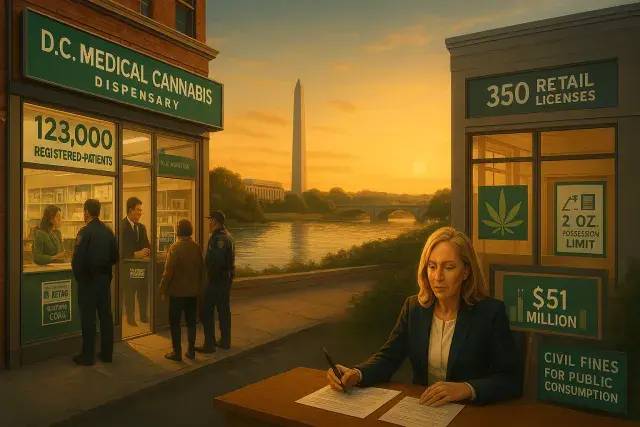
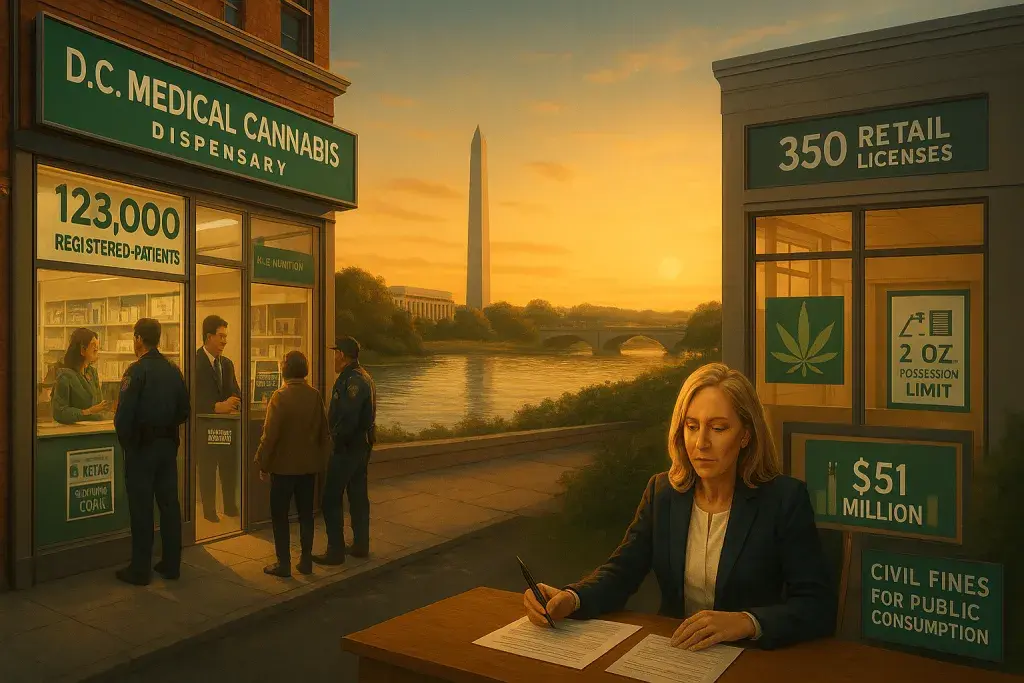
Washington, D.C.'s medical cannabis program posted its strongest month on record in May, with registered patients reaching 123,826 - a gain of more than 7,000 from April - and industry-wide sales hitting $10 million, up nearly 12% year-over-year. At the same time, city regulators shuttered three more unlicensed facilities, continuing a sustained enforcement push that reflects ongoing pressure on the licensed market from illicit operators. Together, these numbers tell a story about what a maturing medical program looks like when compliance infrastructure tightens and patient access expands simultaneously.
The patient enrollment surge is worth examining closely. A jump of more than 7,000 registrations in a single month isn't routine; it suggests either a targeted outreach effort, a regulatory or administrative change that reduced friction in the sign-up process, or some combination of both. For licensed dispensary operators in D.C., a larger registered patient base translates directly into addressable foot traffic and wholesale demand - but only if the operational side can keep pace. Inventory planning, budroom staffing ratios, and POS throughput all have to flex with demand spikes. Operators in adjacent regulated markets watching enrollment trends - including those evaluating point-of-sale for New York dispensaries - understand that compliance-ready technology is foundational when patient volumes climb quickly, because seed-to-sale tracking requirements don't pause for a busy weekend.
Enforcement Actions Signal a Market Still Under Pressure
Three more unlicensed facility closures in May is not a footnote. D.C. has contended with a persistently active gray market - partly a legacy of the city's unusual legal framework, where gifting arrangements operated in a murky space for years before enforcement priorities sharpened. Licensed dispensaries have long argued that unlicensed competitors undercut them on price precisely because those operators carry none of the compliance overhead: no excise tax liability, no lab-tested COAs required, no compliant packaging costs, no METRC logging. When regulators close three facilities in a single month, it signals intent - but operators know that enforcement alone doesn't eliminate demand for unlicensed product. Price parity and consumer education matter too.
For licensed operators, each closure theoretically compresses illicit supply and pushes price-sensitive consumers toward the regulated market. In practice, though, that conversion isn't automatic. If a consumer's primary motivation was price, a licensed dispensary at full tax load may not immediately feel like a compelling alternative. This is one reason D.C.'s 12% year-over-year sales increase matters - it suggests the licensed market is gaining traction on its own terms, not just absorbing displacement from enforcement actions.
Virginia's Retail Framework Sets a Long Planning Horizon
Meanwhile, just across the Potomac, Virginia is finally building the retail scaffolding its adult-use program has been missing. New budget legislation authorizes up to 350 recreational cannabis retail licenses statewide, with the application window opening February 1 and the first shops permitted to open July 1, 2027 - five years after possession was first legalized. That gap is almost impossible to explain to a consumer, but for B2B operators, it creates a defined runway for preparation.
The law raises the possession limit from one ounce to two, keeps home cultivation legal, and projects approximately $51 million in state revenue from the combined excise and sales tax structure in year one. Gov. Abigail Spanberger negotiated the final compromise after vetoing an earlier version, which means the framework reflects real political trade-offs. One of those trade-offs has drawn criticism: a provision increasing civil fines for public consumption. Advocates have raised legitimate concerns that elevated fines - particularly in a state with significant racial and economic disparities in prior cannabis enforcement - could result in disproportionate outcomes even within a legalized framework. That's not a compliance abstraction. It's the kind of provision that shapes how front-line budtenders discuss responsible use with customers and how dispensaries structure their public-facing communications.
What Operators Should Be Watching Now
For anyone positioning to enter the Virginia market, the February 1 application date is the hard deadline that structures everything else. License caps at 350 statewide mean competition for retail permits will be real. Social equity provisions, local zoning approvals, lease structures, and banking access all need to be in order well before applications open - because in regulated cannabis retail, the operators who treat licensing as a paperwork exercise routinely lose ground to those who build compliance infrastructure first. Wholesale supply chain relationships, compliant packaging procurement, and POS system selection should all be in active planning now, not in January 2027.
The D.C. numbers and the Virginia legislation, read together, point to a regional market that is consolidating around licensed operators - slowly, unevenly, but directionally. Patient enrollment records and year-over-year sales growth in D.C. suggest the medical framework is working as designed. Virginia's retail authorization, however delayed, creates a large new market within driving distance. The question for regional operators isn't whether to pay attention. It's whether their compliance and operational infrastructure is ready for both.