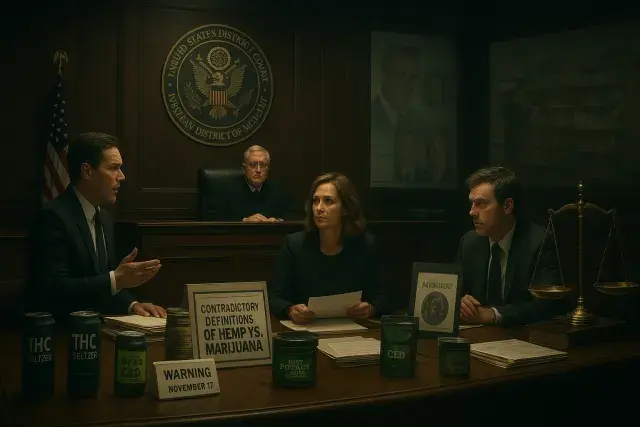
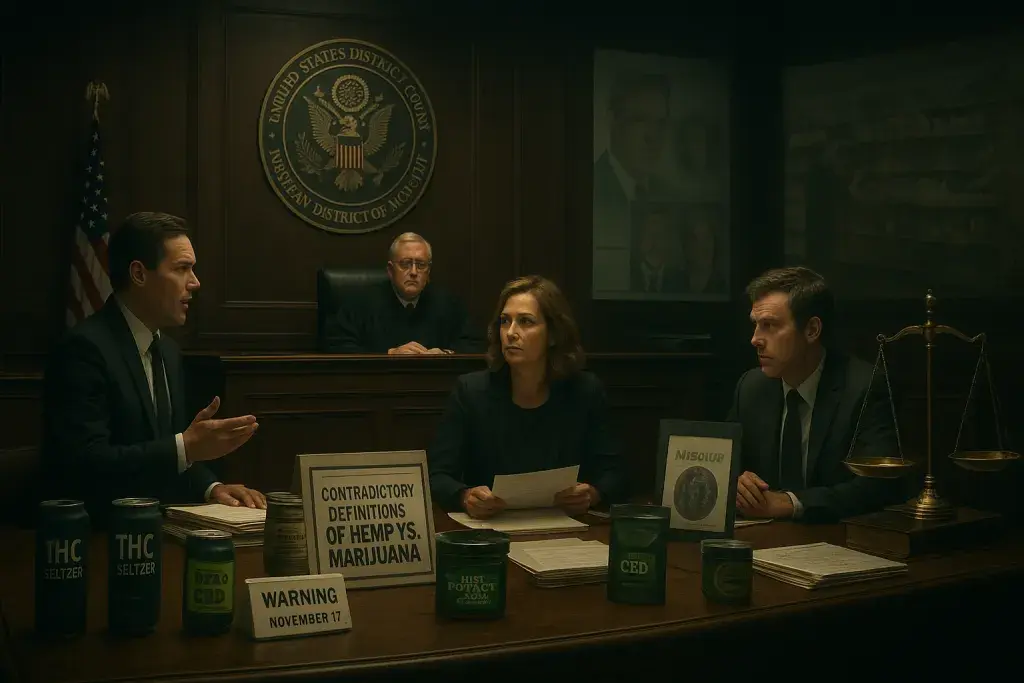
A coalition of hemp retailers and trade groups filed a federal lawsuit Thursday challenging a Missouri law that would pull intoxicating hemp products from store shelves statewide starting November 12. Filed in the U.S. District Court for the Western District, the suit argues that the legislation - House Bill 2641, signed by Gov. Mike Kehoe earlier this year - contains definitions so internally contradictory that businesses, prosecutors, and law enforcement cannot reliably determine what is legal and what is not. For the licensed cannabis and hemp retail sectors, the implications extend well beyond Missouri.
The plaintiffs include MNG 2005, Inc., the St. Louis-based parent company of 55 CBD Kratom stores nationwide; the Missouri Hemp Trade Association; and Wisconsin-based Lifted Liquids Inc. Their core argument: the bill defines identical products as both "hemp" and "marijuana" in different provisions, and because unlicensed marijuana activity carries criminal penalties in Missouri, that definitional contradiction doesn't just create regulatory confusion - it creates criminal exposure for compliant businesses. Operators in other regulated states dealing with similar definitional friction - including those using a Colorado dispensary POS platform to track SKU-level compliance across product categories - understand exactly how costly it is when a state's statutory language doesn't map cleanly onto product reality.
The compliance problem here is structural, not incidental. HB2641 was designed primarily to align Missouri state law with the federal hemp ban Congress approved last year - giving state law enforcement and prosecutors authority to enforce that ban after November 12. But according to the lawsuit, the drafting went sideways. Craig Katz, government relations and compliance manager for MNG 2005, put it plainly: legislators who don't fully understand the chemistry and commercial distinctions within cannabis will produce legislation that reflects that gap. "A lot of this stuff is kind of in the weeds," Katz said. "It's very difficult to understand. And when people are trying to legislate it, if they don't understand it, you come up with something like HB2641, which doesn't make a whole heck of a lot of sense."
What the Law Actually Does - and Where It Gets Complicated
On its face, HB2641 is straightforward: ban intoxicating hemp products from general retail - think THC seltzers currently sold in bars and grocery stores - and restrict any future sales to licensed marijuana dispensaries, but only if Congress reverses course on the federal ban. If Congress delays the federal ban, Missouri's law would still prohibit all intoxicating hemp products except beverages. Enforcement authority sits with Attorney General Catherine Hanaway. The bill's sponsor, Rep. Dave Hinman (R-O'Fallon), has framed the lawsuit as a last-ditch effort by an industry unwilling to accept that the legislative process has run its course.
Fair enough - but the coalition's objection isn't to the policy goal. It's to the execution. The lawsuit specifically flags three drafting problems: first, the contradictory dual classification of the same products as both hemp and marijuana; second, provisions that restrict who may transport hemp products through the state, which the coalition argues interferes with interstate hemp commerce in violation of federal law; and third, effective-date provisions described as "so convoluted that businesses cannot determine which products are covered or when." That last point matters enormously for inventory management. Retailers need clear compliance windows to pull SKUs, notify distributors, and update point-of-sale systems. Ambiguous effective dates don't just create legal risk - they create operational paralysis.
The Broader Regulatory Stakes for Hemp and Cannabis Retail
Missouri isn't operating in a vacuum. The collision between state hemp regulation and the federal statutory framework has been building since the 2018 Farm Bill opened the door to hemp-derived cannabinoids. What followed was a years-long scramble by states to regulate intoxicating hemp products - delta-8 THC, THC-infused beverages, high-potency CBD products - that weren't clearly captured by existing marijuana licensing regimes. Without regulation, Missouri's current market includes intoxicating hemp products with as much as 1,000 mg of THC sold in smoke shops, entirely outside the licensed dispensary structure. That's the market reality the legislature was trying to address.
The problem is that the mechanism the legislature chose may sweep up non-intoxicating CBD products alongside intoxicating ones - an outcome the coalition says would effectively eliminate an entire legal product category and hand a government-mandated sales monopoly to licensed dispensaries. "This isn't consumer protection," said Jay Patel, the Missouri Hemp Trade Association's president. "It's the elimination of an entire legal industry coupled with a government-mandated monopoly." Whether or not the court agrees with that framing, the underlying tension is real: licensed marijuana operators and unregulated hemp retailers have been competing in an increasingly blurred product space, and states are under pressure to draw lines that are legally defensible, commercially coherent, and enforceable by local prosecutors who aren't cannabis policy specialists.
What Operators Should Watch Between Now and November
The defendants - Gov. Kehoe, Attorney General Hanaway, and Missouri Department of Health and Senior Services Director Sarah Wilson - have not yet formally responded. Hanaway's office indicated it had not been served as of Thursday. Both the governor's office and DHSS declined comment given pending litigation.
For hemp businesses operating in Missouri, the November 12 date remains operative until a court says otherwise. That means operators need to be preparing for two scenarios simultaneously: compliance with the ban as written, and a potential injunction that keeps current product lines legal through the holiday retail period. Either way, wholesale purchasing decisions, inventory drawdowns, and distributor contracts should account for both outcomes now - not after a ruling drops two weeks before the deadline. Businesses waiting for legal clarity before making supply chain decisions risk being caught short in either direction. The court's timeline is its own, and it rarely aligns with a retailer's restocking schedule.