
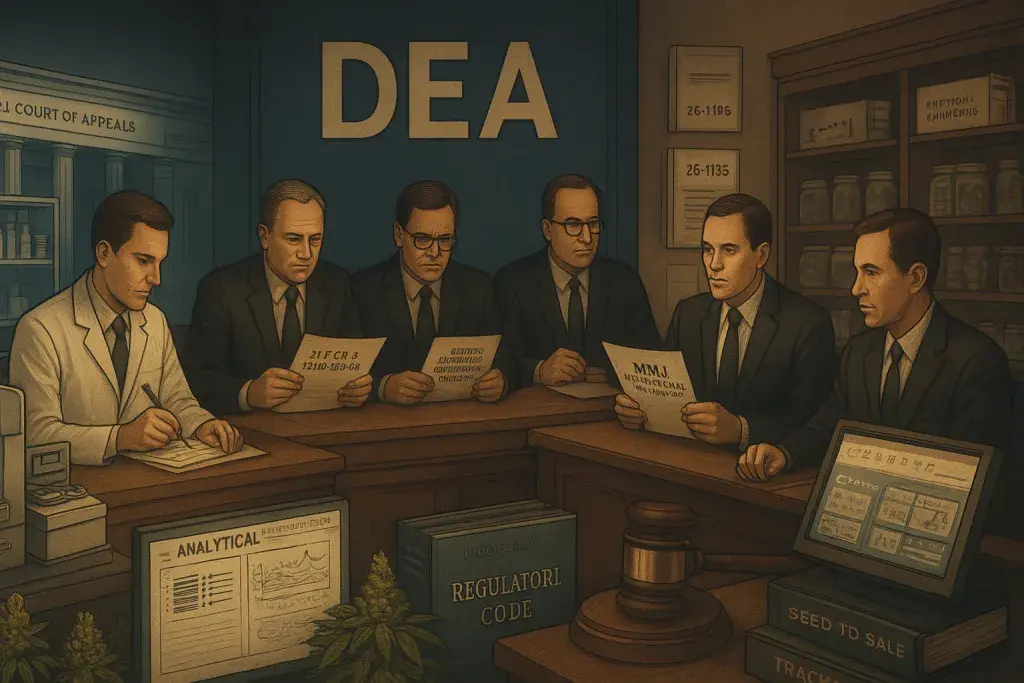
A federal regulation that has gone largely unnoticed in the marijuana rescheduling debate is now being placed front and center - and it raises questions that neither the DEA nor state cannabis industry stakeholders have fully answered. As the agency prepares for its June 29 administrative hearing on moving marijuana from Schedule I to Schedule III, MMJ International Holdings, Inc. (MMJIH) is pressing a straightforward but uncomfortable argument: the products expected to benefit from rescheduling may not meet the chemical-consistency standard that DEA already codified in its own 2020 Final Rule.
The regulation in question - 21 C.F.R. § 1318.05(b)(2) - requires federally authorized marijuana manufacturers to demonstrate the ability to "consistently produce and supply cannabis of a high quality and defined chemical composition." That language went into effect as federal law in December 2020. It is not a guideline. For dispensary operators tracking compliance requirements across state lines, the gap between that federal standard and how state-licensed cannabis is actually produced and tracked - through programs built around seed-to-sale systems, state-mandated COAs, and tools like a dispensary pos system New Jersey operators rely on to manage inventory and regulatory reporting - reflects just how differently federal pharmaceutical standards and state retail cannabis frameworks are structured.
Here's the core tension. State-licensed cannabis programs are built on principles of commercial agriculture and retail compliance, not pharmaceutical manufacturing. A dispensary selling flower or concentrate operates under state testing and labeling rules. Batches are tested for potency and contaminants. Certificates of analysis accompany products through the supply chain. But potency ranges shift harvest to harvest. Cultivar genetics change. The same product SKU may carry a different cannabinoid profile from one production run to the next. That is not a failure of state programs - it is simply not what those programs were designed to prevent. They were built to protect consumers from unsafe products, not to achieve the chemistry, manufacturing, and controls (CMC) reproducibility the FDA expects from prescription pharmaceuticals.
What the DEA's 2020 Rule Actually Established
When DOJ and DEA expanded the federal marijuana cultivation program in 2020, the rulemaking did more than open the door to additional authorized manufacturers. It set an explicit quality benchmark. The "defined chemical composition" requirement mirrors language familiar to anyone who has worked in pharmaceutical development - it is the kind of standard that governs active pharmaceutical ingredients, not commodity agricultural products. MMJ has spent more than eight years pursuing cannabinoid medicines through the FDA's Investigational New Drug process, investing in pharmaceutical manufacturing, analytical testing, stability studies, and quality systems built around exactly that framework. The company spent over $10 million doing so.
What MMJIH is now asking, formally and through pending consolidated petitions before the U.S. Court of Appeals for the D.C. Circuit, is whether the federal government intends to apply that standard selectively. If a company seeking a federal cultivation license must demonstrate reproducible chemical composition, what happens when state-market products - which were never designed to meet that threshold - are granted the legal and regulatory benefits associated with Schedule III status?
The Practical Stakes for Licensed Cannabis Businesses
For multi-state operators and cannabis brands, rescheduling has been framed primarily as a tax question - specifically, relief from the Section 280E provision of the Internal Revenue Code, which currently prevents plant-touching businesses from deducting ordinary business expenses. Schedule III status would eliminate that restriction. It would also affect banking access, insurance underwriting, and the broader perception of cannabis among institutional investors. Those are real, material benefits.
The thing is, rescheduling a substance carries regulatory obligations alongside those benefits. Schedule III drugs occupy a defined place in the Controlled Substances Act framework. Prescription requirements, manufacturing standards, and federal oversight come with that classification - at least for substances that have gone through FDA approval. Cannabis has not. The mismatch between the commercial state market and the federal pharmaceutical framework is not new, but MMJIH's argument draws attention to a specific codified standard that makes that mismatch harder to paper over. If Schedule III triggers federal scrutiny of product manufacturing quality, operators and brands that have never had to think about CMC documentation may find themselves in unfamiliar regulatory territory.
What the June 29 Hearing Should Address
Administrative hearings on DEA rescheduling proposals are procedurally dense. They are not the place where sweeping policy decisions get made in plain language. But MMJIH's position - reflected in its D.C. Circuit filings under case numbers 26-1106, 26-1130, and 26-1136 - is that the hearing should not treat rescheduling as purely a scheduling question divorced from the manufacturing-quality language DEA itself put into the code of federal regulations.
To put it plainly: if the DEA required some federally authorized cannabis producers to demonstrate defined chemical composition and consistent quality, the agency should explain how it plans to treat products that have never been held to that standard. That explanation matters for patients who may one day receive cannabis-derived products under a Schedule III framework, for physicians who would be expected to rely on product consistency, and for operators and investors who are making significant capital decisions based on what rescheduling is assumed to deliver.
The cannabis industry has spent years building compliance infrastructure under state law - testing protocols, packaging standards, inventory tracking systems, wholesale documentation, and retail point-of-sale controls. That infrastructure serves state regulatory goals effectively. Whether it satisfies the chemical-composition standard embedded in federal DEA regulations is a separate question entirely - and it is one the June 29 hearing has not yet been asked to answer.