Running a cannabis retail store means operating under a level of regulatory scrutiny that most other retailers never face. Every transaction, every gram sold, every product transferred from your back room to your display case can be subject to state audit. A single compliance failure can cost a dispensary its license. That pressure alone makes the choice of a dispensary POS system one of the most consequential operational decisions you will make - not just a software purchase, but the backbone of how your business runs, proves compliance, and scales.
Yet many dispensary owners approach this decision the same way they would choose a coffee shop register: by comparing price tiers and counting features on a checklist. The result is often a system that handles basic sales but collapses under the weight of state reporting requirements, real-time inventory discrepancies, or peak-hour transaction volumes. Understanding what separates a functional weed shop POS from one that actively protects your license and grows with your business requires looking at the full operational picture - from seed-to-sale tracking to customer loyalty integration. Exploring purpose-built point of sale systems for dispensaries early in your research will clarify exactly what the cannabis retail environment demands of its technology stack.
This guide walks through every dimension of that decision: compliance architecture, inventory logic, hardware requirements, software integration, vendor reliability, and total cost of ownership. Whether you are opening your first location or replacing a system that has outgrown your operation, what follows will give you the framework to choose with confidence.
Why Cannabis Retail Demands a Specialized Point of Sale System
The Compliance Gap Between Generic and Cannabis-Specific POS
A standard retail POS system is designed to move products and record revenue. A marijuana dispensary point of sale system must do all of that while simultaneously satisfying the reporting requirements of state cannabis control boards, integrating with seed-to-sale tracking platforms like Metrc or BioTrack, and enforcing purchase limits at the transaction level. These are not features you can bolt onto a generic system with a plugin. They require the software to be architected around cannabis compliance from the ground up.
When a budtender completes a sale in a compliant system, the transaction automatically decrements inventory in real time, reports the sale to the state traceability system, checks the customer's remaining purchase allowance for the day, and generates a compliant receipt - all before the customer reaches the door. A generic POS handles none of this natively. Trying to manage these workflows manually, or through disconnected spreadsheets and add-ons, introduces the exact kind of human error that triggers compliance violations.
State Traceability Integration as a Non-Negotiable Feature
Most legal cannabis markets in the United States require dispensaries to report sales data directly to a state-mandated traceability platform. The specific platform varies by state - Metrc dominates across many markets, while others use BioTrack or proprietary systems. Your cannabis retail software must have a certified, maintained integration with whichever system your state uses.
"Certified" is the operative word. Some vendors claim compatibility but rely on manual data exports rather than live API connections. That gap creates reporting delays and reconciliation problems that can accumulate into audit liabilities. Before committing to any system, confirm directly with the vendor that their traceability integration is bidirectional, real-time, and certified by the relevant state authority.
Purchase Limits and Age Verification Enforcement
Many states impose daily purchase limits on recreational cannabis - commonly measured in grams of THC equivalent across different product categories. A compliant dispensary POS system tracks each customer's purchases within the allowable window and blocks or flags transactions that would exceed legal limits. This enforcement cannot rely on budtender memory or manual calculation during a busy Saturday afternoon.
Similarly, age verification workflows must be embedded in the transaction flow, with ID scan capability that flags expired documents and records verification for audit purposes. Systems that treat these as optional add-ons rather than core transaction logic create preventable compliance exposure.
Core Features of Effective Dispensary Inventory Management
Real-Time Inventory Tracking Across Product Categories
Cannabis retail carries a more complex inventory profile than most product categories. Flower is sold by weight; concentrates come in fixed-weight packages; edibles, tinctures, and topicals each carry their own unit and dosage structures. Effective dispensary inventory management must track all of these simultaneously, in real time, with automatic decrements at the point of sale.
The distinction between "real time" and "end-of-day batch updates" matters enormously in practice. Batch-updated inventory creates windows where your displayed stock counts are inaccurate - leading to selling products that have already run out, or failing to reorder in time. Real-time inventory directly connected to your weed shop POS eliminates that lag and gives floor staff accurate information when customers ask about availability.
Receiving, Manifests, and Incoming Transfer Management
Inventory management in cannabis dispensaries begins before products reach the sales floor. When a transfer arrives from a licensed cultivator or manufacturer, the receiving process must match incoming manifest data against state traceability records, verify package tags, and update your internal inventory - all with documented accuracy. A system that automates this workflow reduces receiving errors and creates a clean chain of custody from the moment products enter your facility.
Look for systems that allow staff to receive transfers directly from a mobile device on the receiving dock, with barcode or QR scanning to match package tags against manifests. The alternative - manually entering package IDs and weights into a desktop system - is slow and prone to transcription errors that surface during audits.
Waste Tracking and Adjustment Workflows
Cannabis products degrade, packages get damaged, and samples are sometimes used for quality assessment. Each of these events must be recorded as a formal inventory adjustment with a documented reason code. States differ on how waste must be reported, but all require that your on-hand inventory in the traceability system matches what is physically present in your store. A gap between the two is a compliance red flag.
Your dispensary inventory management system should support structured adjustment workflows with pre-configured reason codes, supervisor approval requirements for adjustments above a threshold, and automatic reporting to the state traceability platform where required.
Low-Stock Alerts and Reorder Triggers
Stockouts in a dispensary are both a lost revenue event and a customer experience problem. A customer who comes in specifically for a product that is perpetually out of stock will find another dispensary. Configure your system with minimum stock thresholds for high-velocity SKUs, and ensure it generates actionable alerts - not just a dashboard indicator that only surfaces if someone actively checks. Integration between your cannabis retail software and your purchasing workflow turns inventory alerts into reorder actions without requiring manual monitoring.
Evaluating the User Experience for Budtenders and Managers
Transaction Speed and Queue Management
During peak hours - weekend afternoons, post-work rushes, promotional days - transaction speed is the difference between a smooth customer experience and a waiting room full of frustrated buyers. A marijuana dispensary point of sale interface should enable a budtender to look up a customer, build a cart, apply discounts, process payment, and complete the transaction in under two minutes for a straightforward order.
Test this directly before purchasing. Run a demo with an actual staff member who has not been trained on the system and time a representative transaction. Counterintuitive menu structures, slow load times, or excessive confirmation screens add seconds to each transaction that compound across hundreds of daily sales.
Menu Management and Product Information Display
Budtenders need fast access to accurate product data - strain information, cannabinoid profiles, terpene content, product category, and price - without leaving the POS screen to consult a separate catalog. Integrated menu management that pulls product details directly into the transaction interface reduces the back-and-forth that slows service and increases error rates.
If your dispensary displays menus on digital screens or integrates with online ordering platforms, your weed shop POS should push menu updates automatically when products sell out or prices change. Manual menu management across multiple channels is a significant operational burden that purpose-built systems eliminate.
Manager Dashboards and Reporting
Operational insight requires more than end-of-day sales totals. Managers need to see which products are driving margin, which budtenders are generating the highest average transaction values, what the conversion rate is from floor consultations to completed sales, and where inventory is trending toward stockout. A well-designed dispensary POS system provides these views in configurable dashboards with export capability for deeper analysis.
Pay particular attention to the granularity of sales reporting. Systems that report only at the product category level obscure the SKU-level data you need to make intelligent purchasing and merchandising decisions.
Hardware Considerations for Your Weed Shop
Choosing the Right Terminal Configuration
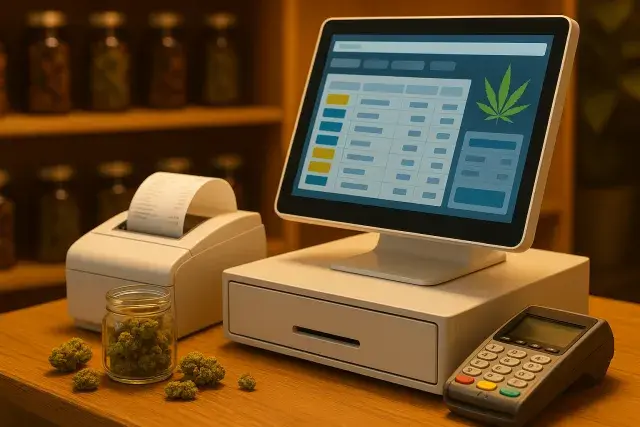
Dispensary hardware configurations range from fixed countertop terminals with customer-facing displays to tablet-based mobile setups that allow budtenders to serve customers on the floor. The right configuration depends on your store layout, customer flow patterns, and whether you operate a traditional counter model or a consultative floor sales model.
Fixed terminals offer reliability and larger screens for inventory-heavy transactions. Mobile tablets offer flexibility but require robust wireless infrastructure and more frequent charging management. Many dispensaries run a hybrid setup - fixed terminals at primary checkout positions with tablets available for floor consultations or overflow capacity during peak periods.
Barcode Scanners, Receipt Printers, and Cash Drawers
Cannabis retail remains heavily cash-dependent in most markets due to federal banking restrictions. That means cash drawer management is a core operational requirement, not an optional peripheral. Your dispensary POS system must support accurate cash drawer tracking, shift reconciliation, and variance reporting to prevent both errors and theft.
Barcode scanners integrated with your POS accelerate product lookup and reduce SKU entry errors. 2D barcode scanners handle both standard barcodes and QR codes common on cannabis packaging. Receipt printers should support the full required label content for your state, including product name, weight, purchase date, and mandatory health warnings, without requiring manual formatting.
Payment Processing in a Cannabis Retail Environment
Standard credit card processing is unavailable to most cannabis retailers due to federal scheduling restrictions. The resulting landscape includes cashless ATM systems, ACH-based payment platforms, and debit processing solutions - each with its own fee structure, compliance considerations, and customer experience implications. Your weed shop POS should support the payment methods your customers actually use and integrate natively with your chosen processor, not through a third-party workaround that creates reconciliation complexity.
Evaluate payment processing fees as part of your total cost of ownership calculation, not as a separate line item. For high-volume dispensaries, a difference of half a percentage point in processing fees translates to meaningful annual cost differences.
Integration Ecosystem: What Your POS Needs to Connect With
CRM and Customer Loyalty Programs
Repeat customers drive a disproportionate share of dispensary revenue. A loyalty program that rewards purchase frequency and encourages customers to return is one of the most direct tools for increasing customer lifetime value. Your cannabis retail software should either include a native loyalty module or integrate cleanly with a dedicated cannabis loyalty platform.
The integration depth matters. A surface-level integration that syncs customer records but cannot apply loyalty discounts in real time during the transaction is operationally clumsy. Budtenders should be able to see a customer's point balance, apply redemptions, and add new points within the normal transaction flow - without switching screens or systems.
Online Ordering and Delivery Management
Where state law permits, online ordering and delivery represent meaningful revenue channels that require tight integration with your marijuana dispensary point of sale system. Orders placed online must decrement your inventory in real time to prevent overselling, flow into the same fulfillment queue as in-store orders, and update the customer automatically when their order is ready or dispatched.
Delivery management adds route optimization, driver tracking, and delivery manifest requirements to the integration picture. Systems that treat online ordering as a separate operational silo - with manual inventory transfers between platforms - create exactly the kind of reconciliation problems that surface as compliance violations.
Accounting and Business Intelligence Tools
Cannabis businesses face heightened accounting complexity due to IRC Section 280E, which disallows most standard business deductions for companies selling Schedule I substances. Accurate, categorized transaction data that flows cleanly into your accounting system is not just a convenience - it directly affects your tax liability. Ensure your dispensary POS system produces financial exports that your accounting software can ingest without manual reformatting.
Beyond accounting, integration with business intelligence platforms allows you to combine POS data with purchasing, staffing, and marketing data for cross-functional analysis. This level of insight becomes increasingly valuable as your operation scales beyond a single location.
Assessing Vendors: Support, Reliability, and Long-Term Fit
Uptime Guarantees and Offline Mode Capability
A cannabis dispensary cannot pause operations while waiting for a software vendor to restore service. Any internet disruption that takes your POS offline costs real revenue and creates compliance gaps. When evaluating vendors, ask specifically about their uptime track record, their SLA commitments, and whether their system includes a functional offline mode that allows transactions to continue processing locally during connectivity interruptions.
Offline mode in cannabis retail is technically complex because state traceability integrations require internet connectivity to sync. A well-designed offline mode queues transactions locally, continues processing sales against local inventory data, and syncs everything to the traceability system automatically when connectivity is restored - with a documented log of the gap period.
Implementation Support and Staff Training
Switching POS systems in a live dispensary is operationally disruptive. The quality of onboarding support - data migration from your previous system, hardware setup, staff training, and the first few days of live operations - has a direct impact on how quickly your team becomes productive on the new platform. Ask vendors for a detailed implementation timeline and references from dispensaries that have completed a migration within the past year.
Training depth matters more than training volume. A vendor that provides ten hours of generic video content is less useful than one that provides four hours of role-specific, scenario-based training for budtenders, managers, and inventory staff separately. Your staff will adopt the system faster when training reflects their actual daily workflows.
Pricing Models and Total Cost of Ownership
Cannabis POS vendors price their software through a range of models: per-terminal monthly fees, percentage-of-revenue fees, flat monthly platform fees, and hybrid combinations. Evaluating these structures on the surface price alone is misleading. Factor in implementation fees, hardware costs, payment processing fees, add-on charges for features like loyalty or online ordering, and the cost of any required third-party integrations.
A system with a lower monthly fee that charges separately for inventory management, compliance reporting, and customer loyalty can easily exceed the total cost of a higher-priced platform that includes all of these as native features. Build a twelve-month cost projection for each vendor you seriously consider before making a final decision.
Making the Final Decision: A Practical Evaluation Framework
Defining Your Non-Negotiable Requirements
Before requesting demos or comparing pricing, document your actual operational requirements in specific terms. Which state traceability platform must the system integrate with? What is your daily transaction volume at peak? How many registers do you need to support simultaneously? Do you operate delivery? Do you need multi-location inventory visibility? These specifics will quickly eliminate vendors that cannot meet your baseline requirements and focus your evaluation on systems that can actually serve your operation.
Separate requirements from preferences. A native loyalty module is valuable, but if it is not available in your preferred system, a well-integrated third-party solution may be adequate. A non-functioning Metrc integration, on the other hand, is disqualifying regardless of every other feature the system offers.
Running Structured Demos with Real Scenarios
Request demos that cover your specific workflows - not the vendor's prepared showcase. Ask them to demonstrate receiving a transfer from a licensed producer, processing a return, handling a transaction that exceeds the daily purchase limit, running an end-of-day reconciliation, and generating a compliance report. How the system handles edge cases tells you more than how it handles ideal-path transactions.
Include the staff who will use the system daily in the evaluation process. Budtenders and inventory managers will identify usability friction that managers reviewing dashboards will miss entirely. Their input is not a courtesy - it is operationally relevant data.
Checking References from Comparable Operations
Ask each vendor for references from dispensaries that closely match your operation profile: similar state, similar volume, similar product mix, similar store model. A glowing reference from a high-volume multi-location chain does not necessarily predict the experience of a single-location boutique dispensary, and vice versa.
When speaking with references, focus on specific operational questions: How long did the implementation take? How does the vendor respond to support tickets? Has the system experienced outages, and how were they handled? Would they choose the same system again knowing what they know now? Direct answers to direct questions are more informative than general endorsements.
Frequently Asked Questions
What is the difference between a dispensary POS system and a generic retail POS?
A dispensary POS is built to integrate with state cannabis traceability platforms, enforce purchase limits, track inventory by weight and package, and generate compliance reports - none of which are native capabilities in generic retail POS systems. Using a non-specialized system in a cannabis dispensary typically requires manual workarounds that create compliance risk and operational inefficiency.
How does dispensary inventory management connect to state compliance requirements?
Most state cannabis regulations require that your on-hand inventory match your records in the state traceability system at all times. Every sale, adjustment, transfer, and waste event must be reported. A compliant inventory management system automates this reporting in real time, reducing the risk of discrepancies that trigger audits or fines.
Can I use a tablet-based weed shop POS instead of a fixed terminal?
Yes, many dispensaries run tablet-based systems successfully, particularly in consultative sales environments. The trade-off is that tablets require reliable wireless infrastructure and regular charging management. For high-volume checkout positions, fixed terminals often provide better reliability and faster transaction throughput, while tablets work well for floor consultations and secondary checkout stations.
What payment methods should my dispensary POS system support?
Most dispensaries need to support cash, cashless ATM, and debit card transactions at minimum, given federal banking restrictions on standard credit card processing. The specific payment solutions available vary by market, so verify which processors operate in your state and confirm that any POS system you consider has a native integration - not a workaround - with those processors.
How long does it typically take to implement a new cannabis retail software system?
Implementation timelines vary based on data migration complexity, hardware setup, staff size, and vendor support quality. A single-location dispensary switching from a previous system can typically complete implementation in two to four weeks, including staff training. Opening a brand-new location with no legacy data often moves faster. Multi-location rollouts require more coordination and typically take longer.
What should I look for in a dispensary POS vendor's support model?
Prioritize vendors who offer live phone or chat support during your operating hours - including evenings and weekends when cannabis retail is busiest. Confirm the average response time for critical issues like system outages. Ask whether your account will have a dedicated support contact or enter a general ticketing queue, and verify whether implementation support is included in the contract or billed separately.