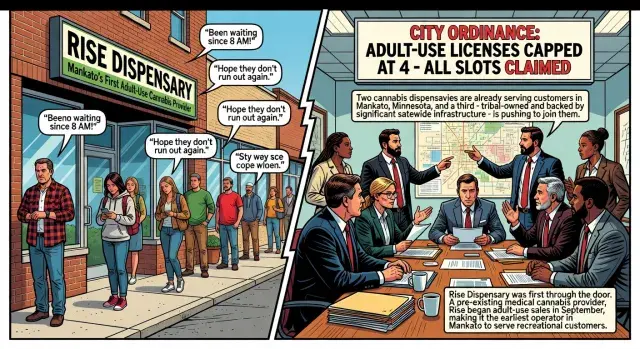
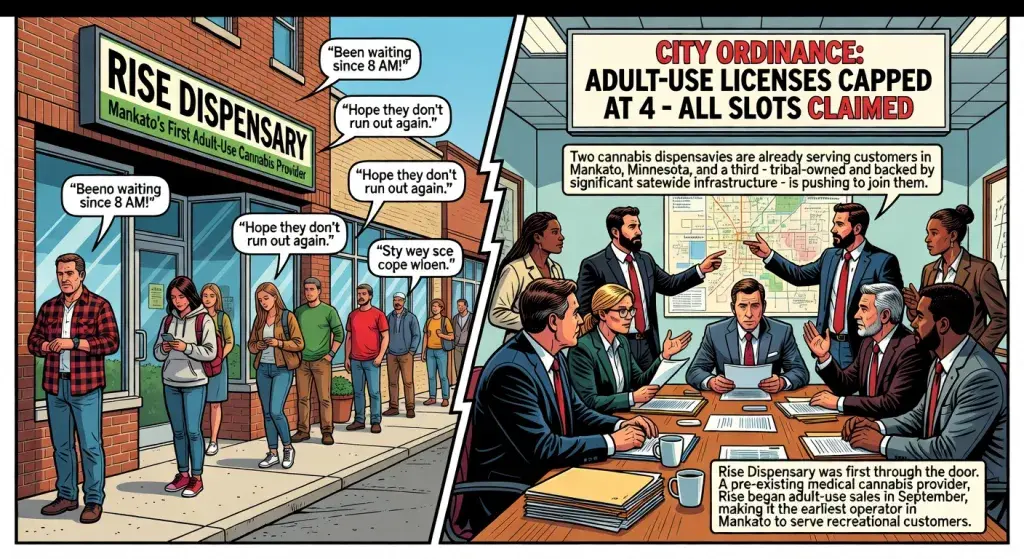
Two cannabis dispensaries are already serving customers in Mankato, Minnesota, and a third - tribal-owned and backed by significant statewide infrastructure - is pushing to join them. With city ordinances capping adult-use licenses at four and officials signaling that all available slots have been claimed, the small southern Minnesota city has quietly become one of the state's more contested retail cannabis markets.
First Movers in a New Market
Rise Dispensary was first through the door. A pre-existing medical cannabis provider, Rise began adult-use sales in September, making it the earliest operator in Mankato to serve recreational customers. But here's the wrinkle: because Rise holds a medical dispensary license, it doesn't count toward the city's four-slot cap on adult-use retailers. That distinction matters. It means all four adult-use licenses remain technically separate from Rise's operation - and competition for them is real.
Voyager Cannabis Company opened two months later, in November, earning the distinction of being the first locally owned dispensary in Mankato. The gap between the two openings was brief, but the difference in ownership structure - corporate medical operator versus homegrown business - reflects a tension playing out across Minnesota's emerging cannabis industry. Who gets to sell, and who benefits, are questions that don't resolve themselves neatly.
A Tribal Operator Eyes Expansion
Island Pezi, the cannabis retail arm of the Prairie Island Indian Community, has announced plans to open a Mankato dispensary within months. The proposed location - 1809 Adams Street in the River Place Center - sits roughly a block from Rise. Proximity like that is no accident; it signals confidence in the local customer base and a willingness to compete head-to-head.
The Prairie Island Indian Community, which also owns Treasure Island Casino, brings scale. Island Pezi operates or partners with more than 50 dispensaries across the state, making it one of the more formidable retail cannabis networks in Minnesota. Discussions with Mankato city officials have been underway for nearly a year.
One unresolved question: whether Island Pezi's tribal-owned status affects its standing under Mankato's dispensary cap. City ordinances give officials discretion over whether tribal dispensaries count toward the four-license limit. So far, the city hasn't said publicly whether Island Pezi has claimed one of the remaining slots - or whether it occupies a different regulatory category altogether. That ambiguity is worth watching.
Why Mankato?
It's a fair question. Mankato's population hovers around 45,000 - not a major metro by any stretch. But it functions as the commercial and institutional hub for a wide swath of south-central Minnesota. Residents from surrounding rural counties routinely drive in for services, shopping, and healthcare. Cannabis retail follows the same gravity.
Scott Johnson, general manager of Tokahe Distribution, has pointed to exactly this dynamic. In his view, Mankato offers operators the ability to grow a customer base while maintaining close working relationships with city officials and the community - a combination that's harder to find in larger, more fragmented urban markets. The city's regional pull, in other words, punches above its population numbers.
A Licensing Bottleneck Takes Shape
With city officials stating that all available dispensary slots have been claimed, newcomers face a closed door - at least for now. Minnesota's cannabis regulatory framework is still maturing; the state only legalized adult-use cannabis in 2023, and municipal governments retain significant control over local licensing and zoning. Mankato's four-license cap reflects a cautious, incremental approach that many Minnesota cities have adopted.
Whether that cap holds, expands, or gets tested by tribal sovereignty questions remains to be seen. The interplay between state law, municipal ordinance, and tribal authority is genuinely complex - and Mankato may end up as a case study in how those layers interact at the local level.
For now, the market is small, tightly regulated, and increasingly crowded. Two operators are open. A third is inbound. And the remaining license slots are spoken for. In a state still building its legal cannabis infrastructure from scratch, Mankato's compressed timeline - from zero dispensaries to a full roster in under a year - offers an early glimpse of how competition, regulation, and community politics will shape this industry across Minnesota's smaller cities.