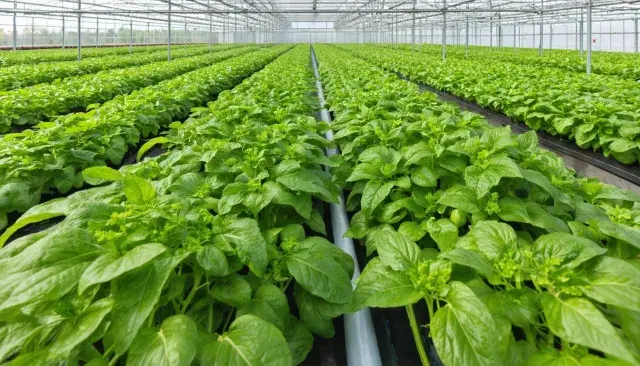
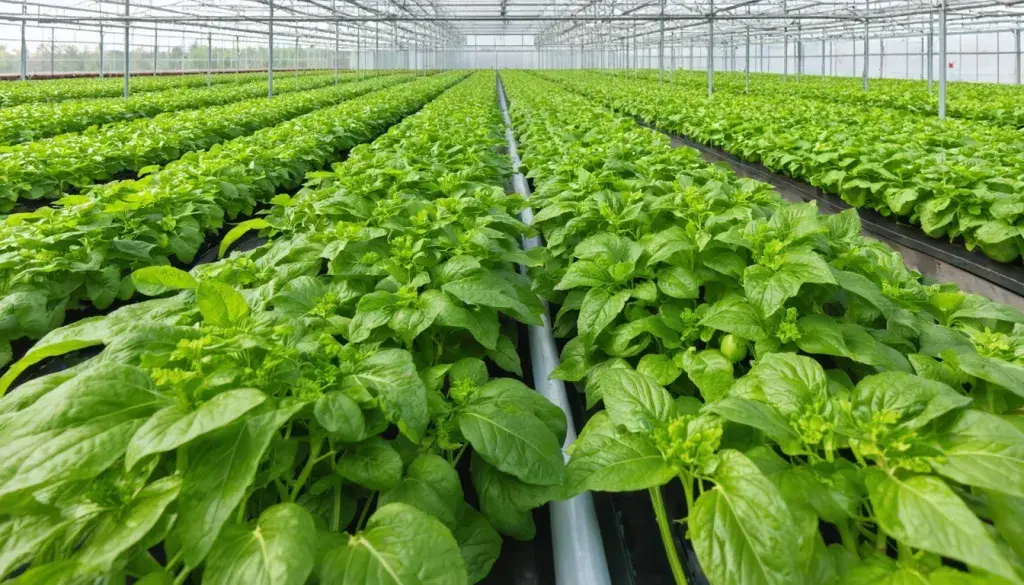
Fresh Venture Farms, a bell pepper propagator in Ontario, Canada, has boosted production by an average of 16% over four years. Growers attribute the gains to enhanced irrigation water quality from cavitating ultrasonic transmitters, nanobubble technology, and reduced hydrogen peroxide use. These methods have cut costs, eliminated synthetic agents, and enabled full water recycling.
Cleaning Irrigation Water Without Chemicals
Clean irrigation water prevents devastating root pathogens like Fusarium and Pythium, which thrive in recirculated systems common to greenhouses. Fresh Venture Farms partnered with Ultramins over four years ago, deploying USAF™ DT-100 cavitating ultrasonic transmitters. These devices generate cavitation—microscopic bubbles that implode with force, rupturing microbial cells mechanically.
Starting with the source pond under orange buoys, the farm expanded to two units for silos and five for daily supply. Last year, nanobubble technology joined the regimen, dispersing tiny oxygen-rich bubbles that enhance root oxygenation and suppress pathogens further. Regular 35% hydrogen peroxide supplements the system, but no other disinfectants enter the loop.
Quantified Improvements in Yield and Costs
Hydrogen peroxide consumption dropped more than 50%, yielding savings of $0.10–$0.15 per square meter annually, according to propagator Florian Locher. Root quality surged, staying robust through full cycles, as photos from the farm illustrate. Synthetic agents vanished entirely, slashing costs per square meter by 40–50%, with return on investment under six months.
Production targets 35+ kilograms per square meter by 2025. Locher calls the setup a no-brainer: "It streamlines irrigation, increases performance, and simply makes growing easier. I practically don't have to worry about my irrigation water anymore."
Verified Pathogen Elimination Drives Confidence
DNA sequencing from A&L Laboratories confirmed high Fusarium and Pythium levels in untreated samples, proving the transmitters' efficacy. Full water recycling—100% reuse—hinges on this certainty. "We've been able to completely eliminate the use of synthetic agents because we haven't had any problems with pathogens," Locher states.
Growers initially tested skeptically in the pond alone. Rapid results prompted scaling, offering a model for propagators facing waterborne risks. Such systems align with pressures for sustainable agriculture, reducing chemical reliance while lifting output.