
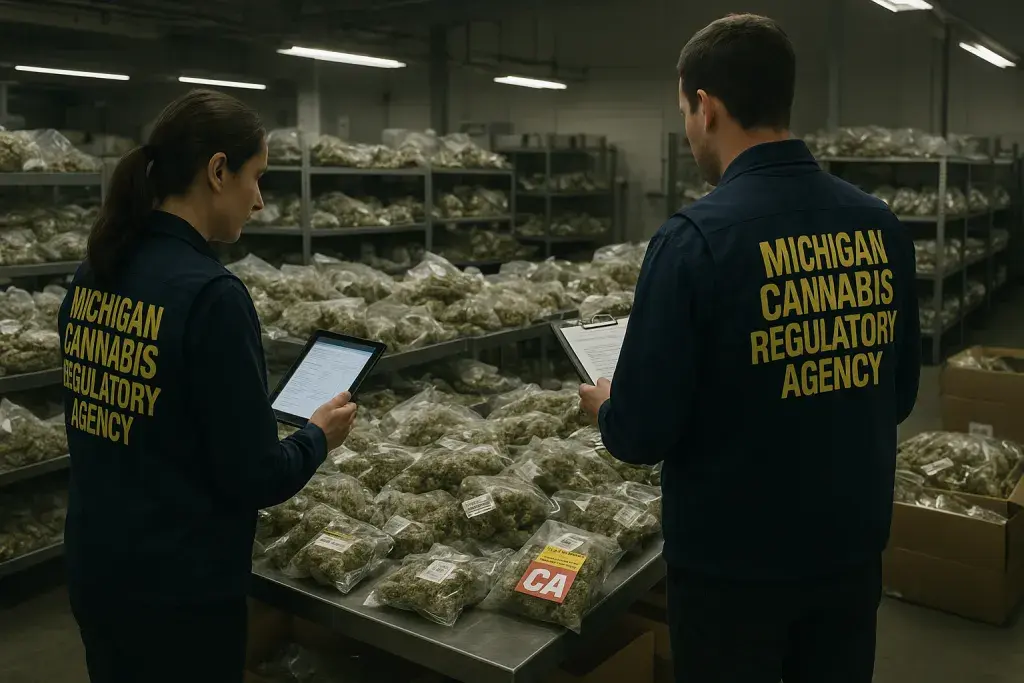
A Michigan cannabis processor is facing license-threatening consequences after state inspectors found more than 12,000 individual cannabis products at its Harrison Township facility with no Metrc tags, no identifying information - and some packaged specifically for the California market. The Michigan Cannabis Regulatory Agency has filed a formal complaint against VJAS 1, citing what amounts to a near-total breakdown of seed-to-sale traceability at the licensed site. The enforcement action puts into sharp relief what regulators treat as a non-negotiable in any compliant cannabis operation: every product on the floor must be accounted for, tagged, and traceable to a source.
The details here are damning. Products bearing California-specific packaging - including "CA" labeling and California-mandated consumer warnings - were found mixed in with the facility's inventory, which employees could not explain. That's not a paperwork gap. That's a signal that product may have entered the facility from outside Michigan's licensed supply chain entirely. Metrc, the state-mandated seed-to-sale tracking system used across most regulated cannabis markets, exists precisely to prevent this kind of opacity. When a licensed processor cannot account for thousands of SKUs in its own facility, the compliance infrastructure has effectively failed. It's worth drawing a contrast here: operators investing in robust point-of-sale and inventory management technology - whether a cannabis pos system new york operators rely on or purpose-built compliance platforms used in Michigan - do so because traceability gaps carry exactly this kind of existential risk to a license.
What makes this case worse is what investigators found when they did locate properly tagged products. Several items carrying valid Metrc tags were, after cross-referencing the state system, supposed to be at other licensed cannabis businesses entirely. That raises a separate and more serious question: how did product assigned to other licensed operators end up at VJAS 1? Metrc tags are not interchangeable. Each tag is generated within the state's tracking system and tied to a specific batch, a specific licensee, and a specific location. Finding misassigned tags at a third-party facility suggests inventory may have moved outside normal licensed channels - or that tags were transferred in ways that don't reflect actual product movement.
What This Means for License Holders Watching the Case
VJAS 1 is now exposed to fines, suspension, restriction, and potential revocation or non-renewal of its license. That's the full range of administrative penalties Michigan's CRA can pursue - and in a case with this many violations, regulators have significant room to act. License revocation is the industry equivalent of a business death sentence; even a suspension long enough to freeze operations can devastate cash flow, supplier relationships, and staff retention.
For other Michigan processors and dispensary operators, the operational lesson is direct: Metrc compliance is not an administrative formality. It is the core of a licensed cannabis business's legal standing. Inventory that isn't tagged doesn't exist in the regulatory record - and inventory that can't be explained becomes evidence in an enforcement proceeding. Facilities running large product volumes need systems and staff procedures that prevent untagged goods from ever reaching the floor, let alone accumulating in quantities that inspectors can measure in the thousands.
The Out-of-State Product Problem Is Bigger Than One Facility
California-branded packaging showing up in a Michigan processor is not just a compliance anomaly - it points toward a broader risk that regulators across mature cannabis markets actively monitor: the infiltration of unregulated or out-of-state product into licensed supply chains. Interstate cannabis commerce remains federally illegal. Michigan law requires all cannabis sold through licensed channels to be cultivated, processed, and distributed within the state's regulated system. Product originating outside that system - regardless of how it's packaged or where it ends up - cannot be legally sold through a Michigan-licensed business.
The gray and illicit market has long used attractive packaging, brand mimicry, and diverted licensed product to place unregulated cannabis into legal retail environments. Whether that's what happened at VJAS 1 is for the CRA's formal proceedings to determine. But the presence of California-specific consumer safety warnings on products inside a Michigan processing facility is the kind of hard physical evidence that drives enforcement cases - and it's difficult to explain away.
Compliance Infrastructure Isn't Optional - It's the Business Model
Regulated cannabis retail operates under a compliance burden that most other consumer goods industries don't face. Every product batch requires a chain of custody. Every transfer between licensees requires a manifest. Every item on a dispensary shelf or in a processor's inventory must carry a Metrc tag that ties it to a verified, in-state origin. That system only works if licensees treat it as the foundation of their operations - not as a reporting obligation to manage after the fact.
VJAS 1's situation is a clear example of what happens when inventory management and regulatory tracking diverge. The gap between what was physically present at the facility and what the Metrc record could account for wasn't a rounding error. It was a systemic failure. And for a licensed cannabis business, systemic compliance failures don't stay administrative problems for long - they become licensing problems, and licensing problems can end businesses.