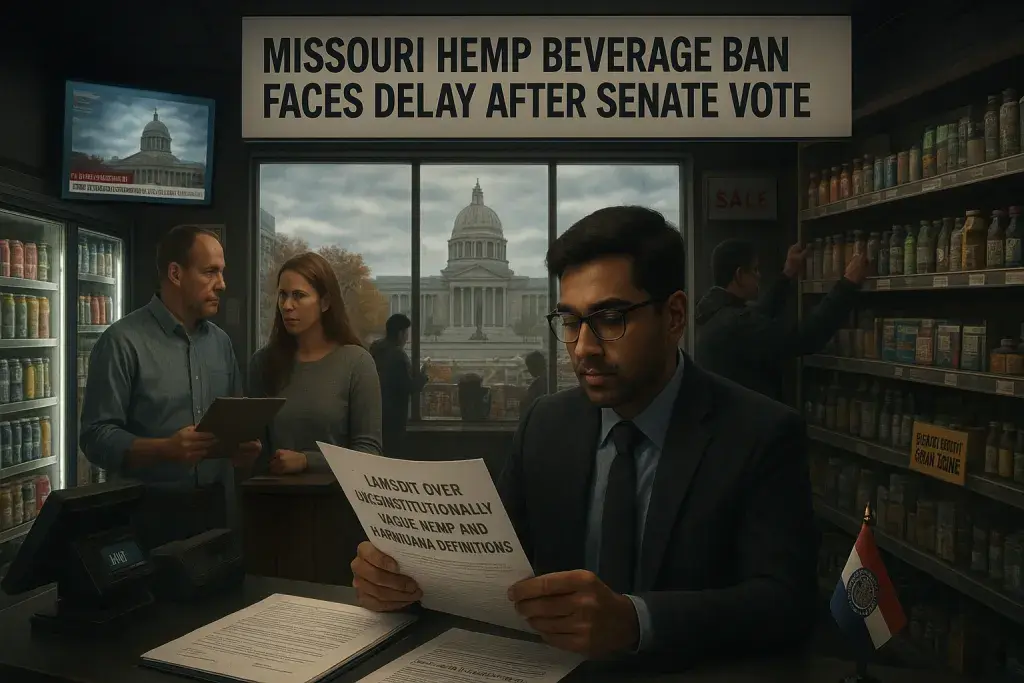
Missouri's Nov. 12 deadline to pull intoxicating hemp products off shelves is suddenly in question. A short-term federal funding bill passed by the U.S. Senate over the weekend would push back the federal ban on intoxicating hemp THC products until Dec. 11 - and because Missouri's own law contains a carve-out tied to federal timing, that delay could keep hemp-derived THC beverages in convenience stores, bottle shops and specialty retailers for another month, even as most other intoxicating hemp products still go dark as scheduled.
Here's the mechanism worth understanding: Missouri Gov. Mike Kehoe signed legislation this spring designed to mirror the federal hemp ban Congress approved last year. But state lawmakers built in a conditional exception - if Congress delays its own ban, Missouri's prohibition narrows to exclude intoxicating beverages specifically. Everything else, from edibles to tinctures, stays banned on schedule regardless of what happens in Washington. That's a strange bit of statutory architecture, and it means retailers now have to track two separate compliance clocks depending on product category. For multi-state operators already juggling seed-to-sale tracking, SKU management and state-specific packaging rules, this kind of bifurcated timeline adds another layer of operational headache - not unlike the compliance patchwork retailers in other emerging hemp and cannabis markets have faced when adapting point-of-sale systems, a challenge platforms supporting cannabis pos utah operators have dealt with as regulations shift state by state.
The bill still needs House approval and the president's signature before it's final, so nothing is locked in yet. Jay Patel, president of the Missouri Hemp Trade Association, called the 61-31 Senate vote a "good sign," but he's careful not to oversell it. Federal delay or not, Missouri's underlying legal fight isn't going away - the association and a coalition of hemp businesses have already filed suit in federal court arguing the state law's definitions of hemp and marijuana are unconstitutionally vague.
What This Means for Retail Operations
For dispensary-adjacent retailers selling hemp-derived beverages - think grocery stores, gas stations, bars, and specialty hemp shops rather than licensed cannabis dispensaries - the practical question is inventory planning. Do you keep beverage SKUs on wholesale menus through December, or do you start clearing stock now given the uncertainty? John Grady, who runs Slaphappy Hemporium in Rosebud with his wife Kara, said customers are already stocking up on items like edibles that face an outright ban no matter what Congress does. That's a familiar pattern in regulated retail: when a category's future gets murky, consumer behavior shifts fast, and operators are left managing shrinkage risk and markdown decisions on compressed timelines.
Beverage-focused hemp brands are in a comparatively better spot, at least short term. Grady noted his company started as a beverage producer, so the delay helps that side of the business even as it does nothing for edibles or other product lines now facing removal. That's the reality of a law written with a single-category exception - it protects one part of a business while leaving the rest exposed.
The Bigger Regulatory Picture
What's striking here is the scramble to use this window productively. Grady and other operators belong to coalitions pushing for comprehensive federal hemp regulation before the Dec. 11 deadline arrives. Patel put it plainly: whatever Congress does won't fully resolve Missouri's problems. State law still bans most intoxicating hemp products, litigation over vague definitions is unresolved, and retailers are left compliant with a moving target rather than a settled rulebook.
For compliance teams, wholesalers, and store operators, the lesson extends beyond Missouri. Hemp-derived THC beverages occupy a regulatory gray zone that state legislatures are still figuring out how to police - closer to alcohol-style oversight in some proposals, closer to outright prohibition in others. Until federal guidance solidifies, expect more of these short-term patches, more litigation, and more operational whiplash for anyone stocking hemp beverages on retail shelves.