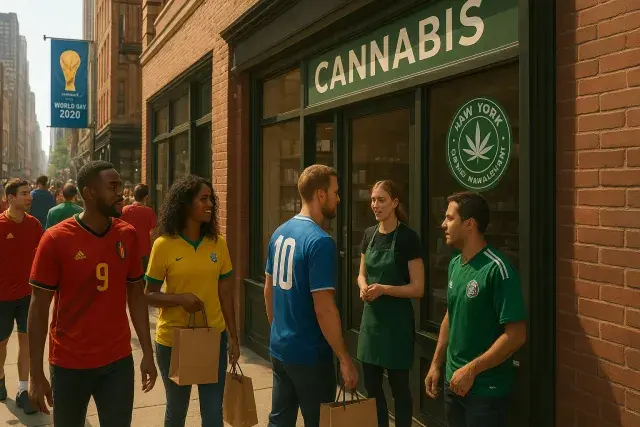
New York's Office of Cannabis Management is running a public education campaign aimed at the hundreds of thousands of international visitors expected in the New York metropolitan area for the 2026 FIFA World Cup - eight matches scheduled between June 11 and July 19 at MetLife Stadium in New Jersey. The goal is straightforward: steer curious tourists toward licensed dispensaries and away from the illegal market, while keeping consumption legal and discreet. For the state's regulated cannabis industry, it's a meaningful window of opportunity - and an operational test.
More than 200 licensed dispensaries operate in and around New York City, and operators are already positioning for elevated foot traffic and delivery volume. Dispensaries running on a compliant cannabis dispensary pos system new york will have a measurable advantage here - managing SKU availability, delivery manifests, age verification, and real-time inventory across a busy promotional window requires systems that don't buckle under volume. For operators planning watch parties, VIP events, or jersey-discount promotions, the compliance infrastructure behind the counter matters as much as the marketing in the window.
OCM Executive Director John Kagia made clear that legal access means tested product. Every licensed dispensary in New York sells cannabis that has passed state-mandated lab testing - verified through a certificate of analysis and reflected in compliant packaging. Illegal market operators make no such guarantees. Kagia specifically flagged the risk of unregulated products being laced with adulterants, a consumer-safety concern that regulators and licensed operators share an interest in communicating loudly. The OCM's licensing sticker - affixed to a shop's front door or window - is the most visible signal a visitor has that a business is operating within the regulated framework.
What Operators Should Know About the Opportunity
The influx of international visitors creates a genuine, if short-term, demand spike. Watch-party culture - spanning hotel common areas, rooftop events, corporate gatherings, and short-term rentals - extends the commercial radius well beyond walk-in retail. Dispensaries with active delivery operations are positioned to capture a significant share of that demand. Delivery manifests, compliant packaging, and driver compliance protocols all need to be buttoned up before volume spikes; a busy promotional period is the worst time to discover gaps in delivery workflow.
Operators running promotional events - like the jersey-discount offers already being organized by at least one Queens-area dispensary - need to ensure those promotions clear state advertising rules. New York's OCM maintains restrictions on cannabis advertising that touch on targeting, placement, and promotional language. Any in-store or event-adjacent promotion should be reviewed against current OCM guidelines before it goes live. The regulatory framework doesn't pause for a busy retail calendar.
The Compliance Briefing Visitors Actually Need
Kagia's public messaging hit three practical points that licensed retailers would do well to reinforce at the point of sale:
- Cannabis consumption is prohibited in public spaces under New York law - the same rules that apply to cigarettes apply to cannabis. That includes outdoor public venues and watch-party locations accessible to the general public.
- Traveling with cannabis by air violates federal law, regardless of the departure or destination state. Visitors purchasing from a New York dispensary should understand the product stays in New York.
- The OCM license sticker on a shop's door is the clearest indicator that a retailer is licensed, state-compliant, and selling tested product. No sticker, no guarantee.
Budtenders and front-of-house staff at dispensaries near high-traffic visitor areas should be prepared to walk international customers through these basics. That's not just good customer service - it reduces the chance of a compliance incident that traces back to a purchase made at a licensed shop.
The Bigger Picture for the Legal Market
New York's adult-use market is still relatively young. Rollout has been slower than many operators and investors anticipated, complicated by licensing delays, ongoing illicit market competition, and the lingering effects of the legal and regulatory disputes that shaped the program's early years. A concentrated period of elevated international tourism doesn't fix structural challenges - but it does provide visible proof-of-concept for what a functioning licensed market can offer.
To put it plainly: if licensed dispensaries handle this well - compliant operations, knowledgeable staff, clean consumer-safety messaging - it builds the kind of credibility the legal market has been working to establish. If the illicit market captures a meaningful share of that visitor demand instead, it's a missed signal. Regulators and operators are, for once, aligned on the outcome they want. The operational execution is up to the industry.