
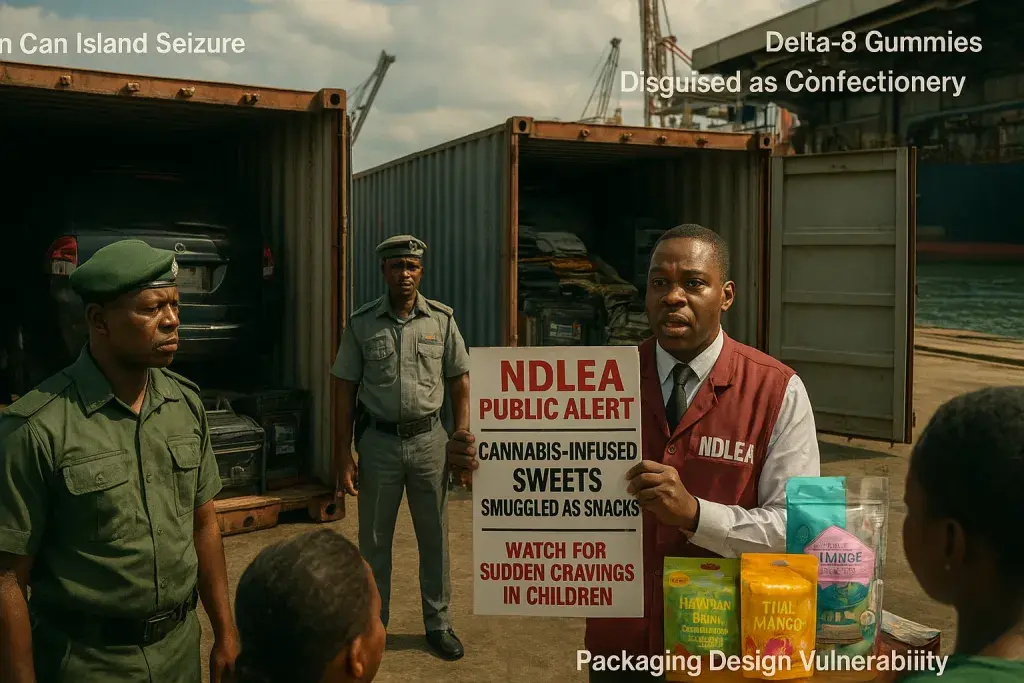
Nigeria's National Drug Law Enforcement Agency has issued a public warning after intercepting shipments of cannabis-infused gummies and cookies disguised as ordinary confectionery. The agency's Director of Media and Advocacy, Femi Babafemi, told parents to pay closer attention to children who show sudden, persistent cravings for cookies and gummies, noting that some packaging conceals far more than sugar and flavoring.
The seizure itself came from the Nigeria Customs Service at Tin Can Island Port in Lagos, where officers pulled two 40-foot containers loaded with used vehicles, generators, batteries and fabrics - and, tucked among them, thousands of Delta-8 pre-roll cookies and cannabis-infused gummy packs. The products originated in the United States, branded as vegan and hemp-derived, with flavor names like Hawaiian Rain Pineapple Guava and Thai Mango. That detail matters for anyone tracking how licensed cannabis retail differs from black-market distribution: legitimate operators in regulated U.S. markets rely on seed-to-sale tracking, batch-level lab testing, and compliant packaging precisely because unregulated products like these can slip across borders with none of that oversight. A dispensary running a proper dispensary pos system Rhode Island can trace every gummy back to its cultivator, its COA, and its manufacture date - none of which existed for the containers seized at Tin Can Island. dispensary pos system Rhode Island
Why Packaging Design Is the Real Vulnerability
Here's the catch with edibles: the same qualities that make them appealing to adult consumers - bright colors, fruit flavors, resealable pouches - also make them indistinguishable from candy to a child. In regulated adult-use markets, this tension is exactly why packaging rules exist. Child-resistant closures, opaque exteriors, and mandatory potency labeling aren't bureaucratic decoration; they're the last line of defense against accidental ingestion. Products moving through informal import channels bypass every one of those requirements. No regulator inspects them, no lab issues a certificate of analysis, and no state tracks the THC concentration per serving. That absence of compliance infrastructure is precisely what turns a snack aisle into a public health question.
What This Means for Licensed Operators and Regulators
For dispensary owners and multi-state operators watching this story from outside Nigeria, the lesson isn't really about one seizure - it's about reputational spillover. Every time counterfeit or smuggled cannabis edibles surface in headlines, licensed retailers absorb some of the public anxiety, fair enough or not. Consumers don't always distinguish between a product sold through a regulated dispensary with verified lab results and one smuggled in a shipping container. That's a branding problem as much as a compliance one.
Regulators in emerging markets are watching too. Jurisdictions weighing adult-use frameworks often point to exactly this kind of incident to justify strict license caps, mandatory testing, and tight advertising rules. In practice, though, prohibition tends to push demand toward unregulated supply chains rather than eliminate it - which is the paradox NDLEA's warning inadvertently highlights. A market with no legal, tested edibles available is a market where illicit, unlabeled ones fill the gap.
Practical Takeaways for Retailers and Parents Alike
- Compliant edibles carry visible batch numbers, potency labeling, and lab-verified COAs - smuggled products rarely do.
- Child-resistant packaging and plain-language warnings remain the strongest deterrent against accidental consumption.
- Retailers should treat consumer education, not just point-of-sale verification, as part of routine compliance.
- Parents unfamiliar with hemp-derived branding terms like "Delta-8" may not recognize risk cues on packaging.
None of this suggests cannabis edibles are inherently unsafe when sold through licensed, tested supply chains. It does suggest that the gap between regulated retail and smuggled confectionery is where real harm happens - and that gap is exactly what agencies like NDLEA, and compliant operators everywhere, are trying to close.