Ama Cimiteri's "Spring 2026" guided tour program at Rome's Verano Monumental Cemetery wraps up on June 2, ending a nine-day run that brought free public access to one of the Italian capital's most historically significant burial sites. The initiative, spread across 43 events, drew visitors through itineraries covering art, civic history, and cultural memory - and this year added features that expanded both its audience and its format.
What the Program Delivered
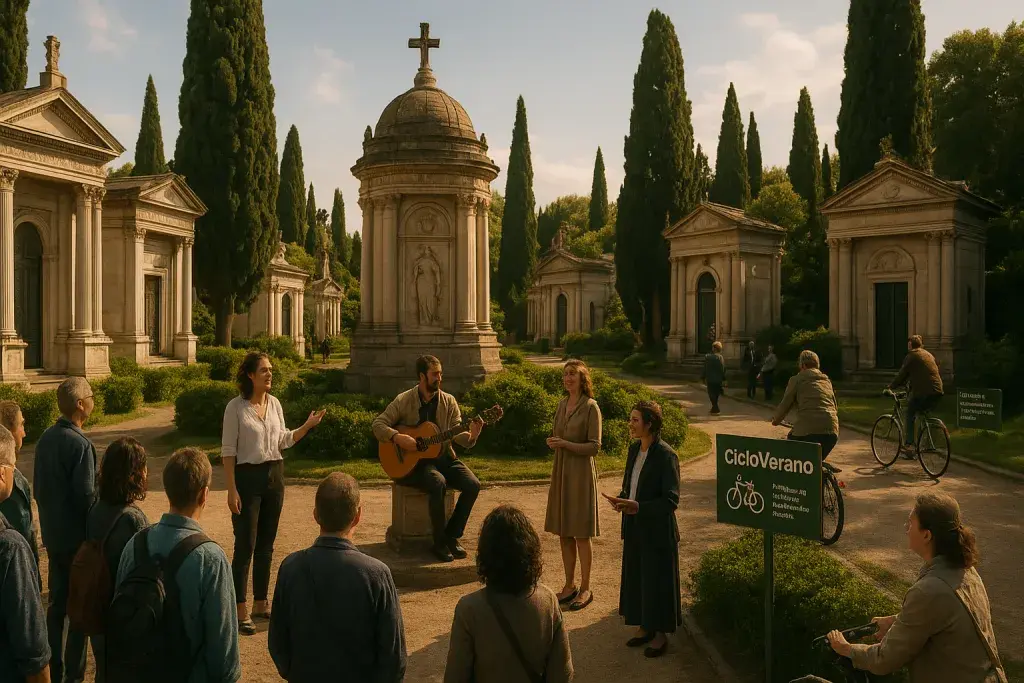
The Spring 2026 edition introduced a bicycle route - "CicloVerano" - marking the first time the cemetery opened a dedicated cycling itinerary. According to Eleonora Lucchetti, Head of Cultural Promotion and Communications at Ama Cimiteri, the bike trail drew strong interest and is already confirmed for the fall season. That kind of measured, iterative expansion - test a format, assess demand, carry it forward - reflects a broader shift in how public heritage institutions think about visitor engagement.
This year's program also included a route dedicated to sports and football figures buried at Verano, a session honoring Ettore Petrolini on the ninetieth anniversary of his death, and a full day on June 2 structured around the 80th anniversary of the Italian Republic. The Petrolini tribute, titled "And I Take My Pride!", featured traveling performances by contemporary artists Daniela Balsamo, Sabina Barzilai, and Maurizio Castè - a production model that pairs site-specific history with live artistic interpretation rather than conventional lecture-format tours.
Accessibility and Institutional Reach
The program made a point of broadening physical and sensory access. Ama Cimiteri partnered with the National Institute for the Deaf in Rome to accommodate hearing-impaired visitors - a detail worth noting not as a footnote but as a design decision. When public heritage programming treats accessibility as structural rather than supplementary, it changes who actually shows up.
The initiative also aligned with the European Historic Cemeteries Week, which ran May 22-31 and situates burial sites within the framework of Goal 4 of the United Nations 2030 Agenda - Quality Education. Verano's participation positions the cemetery not simply as a place of mourning or historical record but as an educational venue with an institutional mandate. Rome's program extended one day beyond the European initiative's close, ending June 2 with the Republic anniversary programming.
The June 2 Closing Day
The final day's programming is structured in four parts, moving chronologically from the Risorgimento and Italian Unification through the two World Wars, the Liberation, and finally the 1946 referendum between monarchy and republic, the Constituent Assembly, and the role of women in shaping the Republic. It's a dense historical arc to cover in a single day - but the format distributes the load across four separate guided tours, each enhanced with musical performances for voice and guitar by Emmanuel Losio and Clelia Liguori, plus live readings on the afternoon route at 3:00 p.m.
All events remain free, but reservations are required and subject to availability. That combination - no admission cost, but a reservation requirement - functions as a practical crowd-management tool while maintaining the appearance of open access. It also generates advance registration data, which any institution running recurring seasonal programming finds useful for planning future editions.
A Model Worth Watching
The Verano program demonstrates what a public institution can do when it treats a heritage site as a living civic resource rather than a static monument. Free entry removes economic barriers. The reservation model keeps events manageable. Thematic programming tied to national anniversaries, cultural figures, and accessibility initiatives gives repeat visitors a reason to return across multiple seasons. Ama Cimiteri is building something cumulative here - and the fall season, with CicloVerano confirmed for a second run, will show whether the audience it has assembled holds.