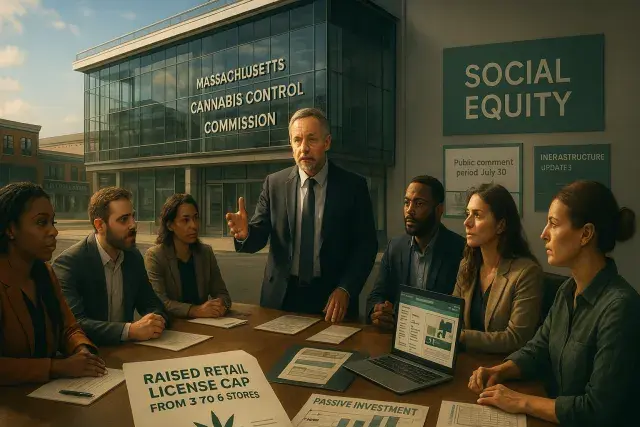
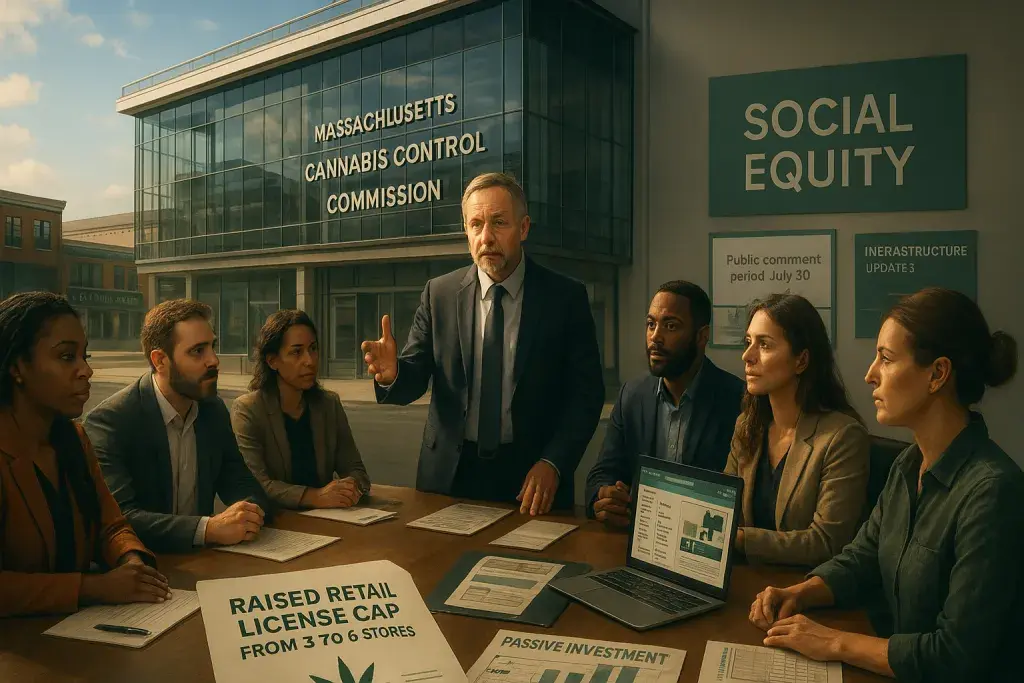
The Massachusetts Cannabis Control Commission moved Wednesday to raise the state's retail license cap - from three stores to six - adopting an emergency regulatory package to meet a statutory deadline embedded in the state's recently enacted cannabis reform law. The vote was unanimous. The new regulations took effect immediately and will remain in force for three months while the CCC collects public input, with a formal hearing scheduled for July 30 and written comments accepted from July 3 through that date.
For multi-unit operators paying close attention to licensing strategy, the timing matters as much as the policy itself. License cap expansions fundamentally reshape how a retail group models store-level economics - from inventory allocation across locations to compliance infrastructure like seed-to-sale tracking and point-of-sale systems. Operators in other regulated markets have faced comparable inflection points; retailers building out in states with evolving frameworks have had to rethink everything from delivery manifests to budroom staffing ratios as their footprint grew. Tools like cannabis pos software nevada illustrate how retail tech vendors have adapted to state-specific regulatory environments, a pattern Massachusetts operators will likely mirror as their licensing options expand.
Here's the catch, though: the expansion isn't available to everyone right away. For the first 12 months the regulations are in effect, only social equity businesses are eligible to hold up to six retail licenses. Non-social equity licensees are capped at five during that same period. That's a deliberate sequencing choice - one the CCC has framed as prioritizing access for communities historically disadvantaged by cannabis enforcement before the broader market scales up. Whether that sequencing holds in practice, or whether larger operators find workarounds through passive financial structures, will be something compliance professionals and advocacy groups will watch closely.
What the Financial Interest Threshold Change Actually Means
One provision that deserves more attention than it's getting: the regulations raise the threshold at which a financial interest in a cannabis business counts against an individual's license cap - from 10 percent to 20 percent. The qualifier is important. That elevated threshold only applies as long as the individual doesn't exercise direct or indirect control over the business. In other words, passive investment at under 20 percent won't trigger the cap. Active control still will.
For investors and multi-state operators structuring deals in Massachusetts, this is a meaningful shift. It widens the lane for capital participation without necessarily triggering license cap attribution - which has historically made it difficult to bring institutional or angel investment into smaller cannabis retail groups without running into regulatory limits. Compliance counsel will need to scrutinize how "indirect control" gets defined and enforced in practice, because that's where the ambiguity lives. A vague definition creates compliance exposure; a tight one creates transactional clarity.
Purchase Limits and the Retail Floor Reality
Separately, the CCC formally updated its regulations to reflect a purchase limit increase that had already gone into law: adult consumers can now purchase up to two ounces of marijuana in a single transaction, up from one ounce. The regulatory update is largely housekeeping at this point - dispensary operators have been aware of the change - but the formal codification matters for compliance documentation, staff training records, and POS system configuration. A transaction limit that exists in law but hasn't been updated in a dispensary's point-of-sale software creates a compliance gap, however technical it may seem.
Store managers should verify that their POS terminals and compliance logs reflect the new limit accurately. That's a small operational lift, but it's the kind of detail that shows up in audits.
What Comes Next - and What Operators Shouldn't Assume
CCC Chair Chris Harding described Wednesday's action as "just the beginning of a comprehensive policymaking process that will unfold over the next year." The commission has signaled it will not immediately open applications for the higher license cap - internal infrastructure updates need to come first. A second round of regulatory changes is anticipated in the fall to address other provisions of the cannabis reform law.
To put it plainly: operators who want to move from three stores to five or six shouldn't expect a fast path to new license applications. The emergency regulatory process runs three months. The public comment period closes July 30. Infrastructure updates follow. The fall rulemaking cycle adds another layer. Realistically, the application window for expanded licenses is a late-2025 story at the earliest.
That's not a criticism of the process - it's a practical read of the timeline. Operators who treat today's vote as a green light to start site selection and lease negotiations for stores four through six should factor in that the licensing mechanism to support those moves isn't fully operational yet. The policy framework is in place. The administrative infrastructure is catching up.
What's striking here is the broader signal: ten years into Massachusetts adult-use legalization, the state is still actively reshaping its foundational licensing rules. For operators, investors, and compliance teams, that's not a settled environment. It's an active one - and it rewards the kind of regulatory attention that most retailers would rather not have to sustain.