
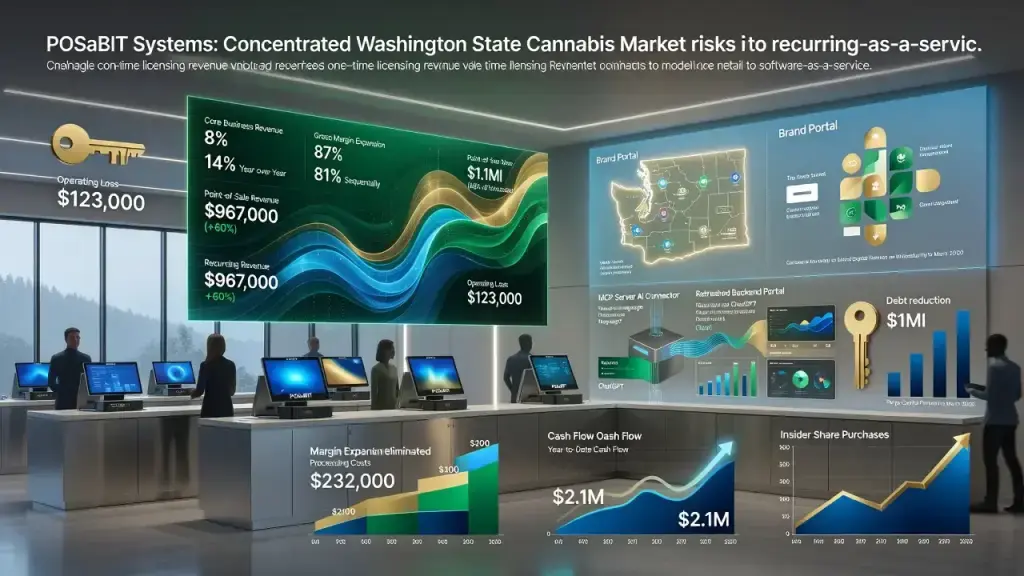
POSaBIT Systems posted a quarter that looked soft on the surface and strong underneath. Total revenue for Q3 2026 came in at $2.3 million, down 2% from a year earlier, but that decline traces almost entirely to a licensing contract moving from a monthly royalty to a per-terminal structure. Strip that transition out, and the cannabis point-of-sale vendor grew core revenue 8% year over year and 14% sequentially, while gross margin expanded six points to 87%. For a small-cap software provider serving licensed dispensaries, that's the kind of mix shift worth unpacking.
Why the Top Line Looks Weaker Than the Business Actually Is
Here's the catch with licensing deals: they can inflate reported revenue in ways that don't reflect the durability of the underlying business. POSaBIT's prior arrangement paid out on a monthly basis; the new structure pays per device, which is smaller and usage-based. CFO Emily Eagon called the resulting adjusted EBITDA decline "a contract timing story," not an operating problem. That distinction matters for anyone reading the headline number in isolation. Licensing cash collected fell from $1.5 million in Q2 to $864,000 in Q3, a drop of more than $600,000 - larger than the entire adjusted EBITDA decline for the quarter. The core business, meanwhile, kept growing on a flat cost base.
Recurring POS Revenue Is Where the Margin Lives
Point-of-sale revenue reached $1.1 million, or 48% of total sales, up 39% year over year. More telling is the recurring slice - $967,000, up roughly 60%, stripped of one-time hardware sales. For dispensary operators, this is the part of a vendor relationship that tends to matter most: software fees, support contracts and payment referrals are stickier than terminal sales, and they carry far better margins. Processing costs tied to POSaBIT's old payment model ran $232,000 in Q3 2025; they're essentially gone now. That alone explains a meaningful chunk of the margin expansion, separate from any volume growth.
Washington Concentration Cuts Both Ways
CEO Ryan Hamlin was direct about strategy: rather than spreading thin across many states, as some competitors do, POSaBIT has concentrated on owning Washington State's cannabis retail data from seed to sale - producers, processors and retailers all on one connected platform. The Brand Portal now includes most of the state's top cannabis brands. In practice, though, that concentration is also the company's clearest risk. A single state's regulatory posture, tax structure, or license cap policy can move the needle on results in ways a multi-state footprint would dilute. Investors weighing the stock should treat the Washington dependency as a real constraint, not just a talking point.
Debt Reduction and the AI Pitch
POSaBIT paid down $1 million of its loan with Perga Capital Partners ahead of schedule while negotiating better terms and extending maturity to March 2030 - a modest but notable move for a company this size, and one that reduces go-forward interest expense. Operating cash flow was $564,000 for the quarter and $2.1 million year to date, a sharp improvement from $305,000 in the same period last year.
The company also shipped an MCP Server - an AI connector letting retailers query sales data through tools like Claude or ChatGPT in plain language - alongside a refreshed backend portal. Framed against the broader retail technology trend toward embedded analytics, this looks like a reasonable bet on where dispensary software margins will come from next: not terminals, but data services layered on top of point-of-sale infrastructure.
- Core business revenue: up 8% year over year, 14% sequentially
- Gross margin: 87%, versus 81% a year earlier
- Operating loss narrowed to $123,000 from $511,000
- Insider share purchases: more than 2 million shares year to date, per management
What's Left Unresolved
Management did not offer quantitative guidance, and capital allocation remains an open question - Hamlin said the board is reviewing reinvestment, a dividend, going private, or other uses of cash, with no decision announced. For a company that spent recent years focused on survival, having options at all marks a shift. Whether that optionality becomes a disciplined plan or stays a list of possibilities is the thing to watch heading into the next few quarters.