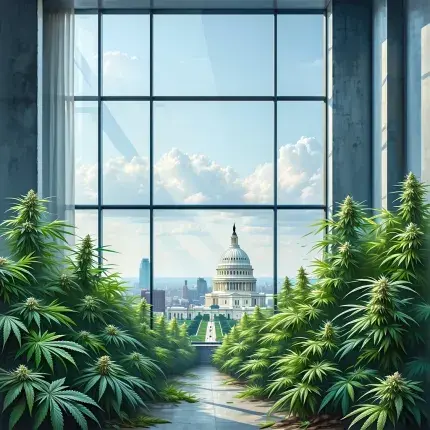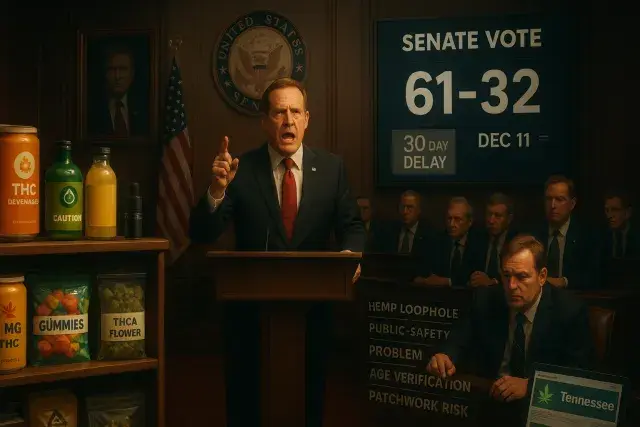
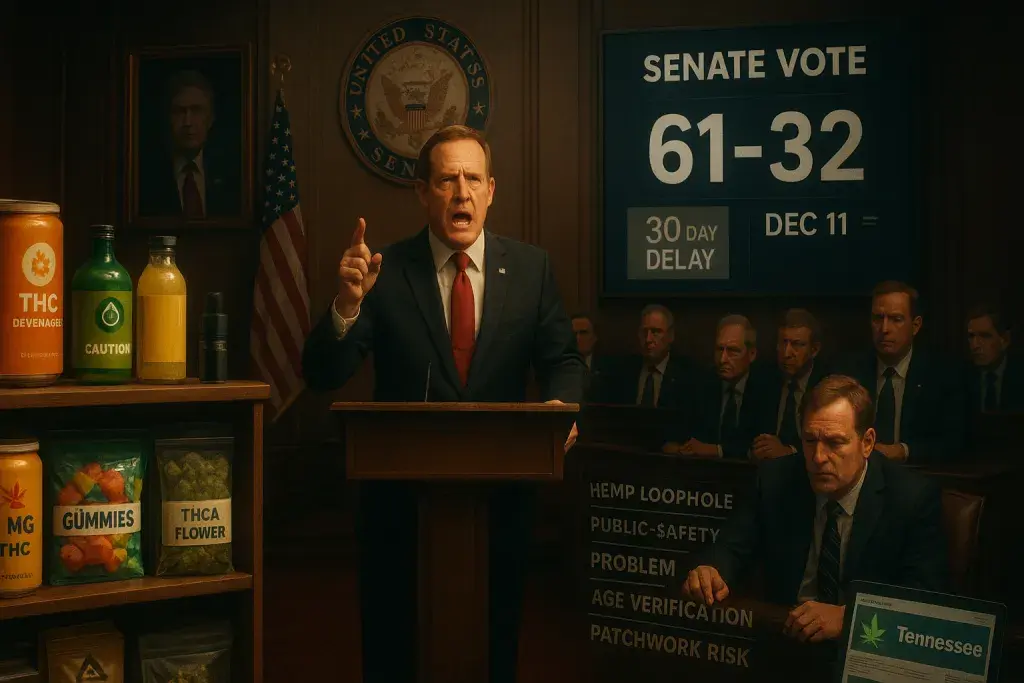
The US Senate has rejected an attempt to accelerate a federal ban on intoxicating hemp products, opting instead to let a 30-day delay stand. Sen. Ted Budd, R-N.C., tried to strip a provision from the chamber's continuing resolution that pushed the effective date of sweeping new hemp restrictions from Nov. 12 to Dec. 11. His amendment failed 61-32 on Aug. 8, with senators voting to table it despite a bipartisan coalition of 21 Republicans and 11 Democrats backing Budd's push.
For hemp retailers, wholesalers, and the compliance teams that keep them on the right side of state and federal law, the vote is less about a single senator's frustration and more about how much runway the industry has left. The underlying law, passed in November 2025, redefines hemp based on total THC content and bars finished hemp-derived cannabinoid products containing more than 0.4 milligrams of combined THC and similar compounds per container. That threshold would functionally eliminate most THC beverages, gummies, vapes, and THCA flower currently sold in convenience stores, smoke shops, and even some licensed cannabis storefronts. Operators trying to track inventory shifts, reformulate SKUs, or plan wholesale menus around that deadline are watching this fight closely - and platforms built for regulated retail, including a cannabis retail platform for Tennessee, are increasingly relevant as state markets brace for federal rules to reshape what can legally sit on a shelf. cannabis retail platform for Tennessee
Why the Delay Mattered to Both Sides
Budd's argument was straightforward: Congress already voted to close what he called the "hemp loophole" nine months ago, and any further delay simply extends the window in which what he described as intoxicating products marketed with candy-like packaging remain available to minors. He cited North Carolina emergency department data showing a steep rise in cannabis-related visits among minors between 2017 and 2025 as evidence of a public-safety problem, not a market inconvenience.
The opposing coalition - 105 organizations, including the US Hemp Roundtable, the National Restaurant Association, and the National Association of Convenience Stores - framed the 30-day delay differently. Their position was that the extra month gives Congress room to legislate real guardrails: age verification, testing standards, packaging rules, and restrictions on synthetic cannabinoids imported from overseas, rather than allowing a blunt THC threshold to wipe out large swaths of the market overnight. That distinction matters for any operator trying to plan a compliant packaging overhaul or renegotiate supplier contracts. A regulatory framework with defined testing and labeling requirements is a very different operating environment than an outright prohibition on products above 0.4 milligrams per container.
Washington Pressure Meets a Divided White House
The dispute also exposed friction between congressional Republicans and the administration. President Trump reportedly called Budd directly as the amendment gathered cosponsors, and CMS Administrator Dr. Mehmet Oz separately warned that letting the broader restrictions take effect on schedule could disrupt efforts to expand access to full-spectrum hemp-derived CBD for seniors and people with disabilities. Budd pushed back, questioning why preserving CBD access required keeping intoxicating hemp products on convenience-store shelves nationwide.
That tension is not academic for compliance officers. When federal messaging is inconsistent - an administration favoring delay while individual senators push for immediate enforcement - state regulators and retailers are left guessing which standard to build toward. The closed-door Senate GOP lunch reported by Axios, where a White House aide told members the administration would not seek another extension beyond Dec. 11, suggests the delay is genuinely final this time, not a rolling grace period operators can count on indefinitely.
North Carolina's Parallel Fight Adds Another Layer
North Carolina's own House Bill 328 would import the same 0.4-milligram threshold directly into state law, independent of whatever Congress ultimately does. The Senate passed the conference report 37-6 in July, but the House has repeatedly declined to act, leaving the bill parked in the Rules Committee. That stalemate matters beyond North Carolina: it's a preview of the fight state legislatures nationwide will likely face as they decide whether to mirror the federal THC threshold, write their own stricter or looser standard, or wait on Washington. For multi-state operators, that patchwork risk is the real operational headache - a product compliant in one state could become contraband in another within the same fiscal quarter.
For now, the federal delay holds, HB 328 remains stalled, and hemp retailers are operating on borrowed time rather than settled law. Inventory planning, wholesale contracts, and compliance logs built around Nov. 12 may need a second revision before Dec. 11 arrives - and possibly a third if state legislatures move on their own timelines.