
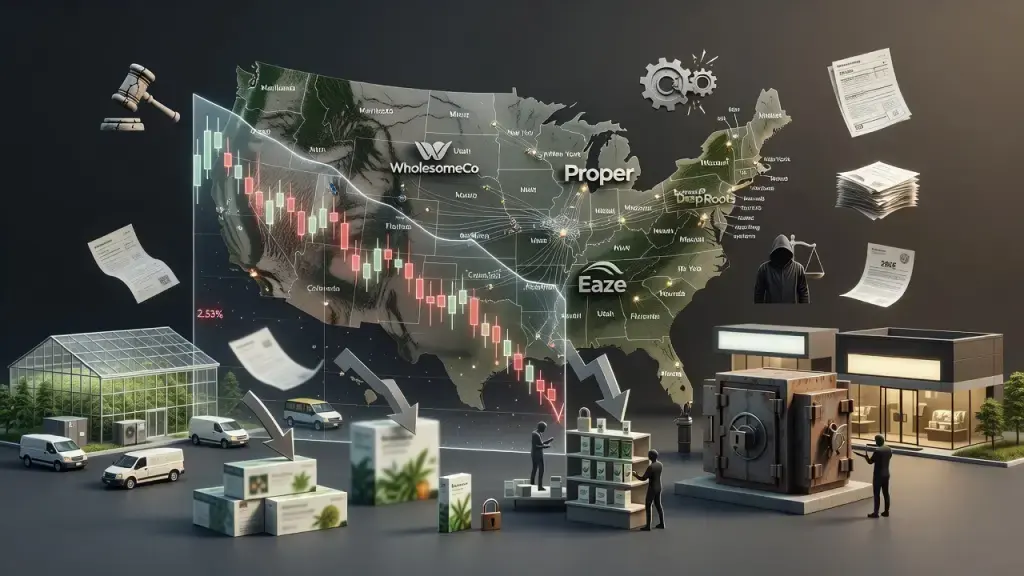
Vireo Growth Inc (CSE:VREO) closed down 2.53% on October 26, 2026, a move that came without an accompanying corporate release. That absence of news is itself informative: the decline appears to reflect how cautiously the market continues to treat US multistate cannabis operators, rather than any specific operational setback at the company.
Vireo has spent much of the past year assembling a considerably larger footprint. What started as a business built around Maryland, Minnesota and New York expanded in 2025 through all-share deals for WholesomeCo, Proper and Deep Roots, adding Missouri, Nevada and Utah to the map. The company then closed a merger with Eaze on April 1, 2026, bringing dispensary exposure in California, Florida and Colorado into the fold. On paper, that's a platform with real scale - vertically integrated cultivation and production in several limited-licence states, paired with a broader retail and distribution layer. In practice, though, scale and performance are not the same thing, and the market knows it.
Why Integration Is the Real Test
Stitching together six acquired businesses across six states is not a back-office formality. It means harmonizing seed-to-sale tracking systems, reconciling wholesale menus, standardizing compliant packaging across jurisdictions with different labeling rules, and bringing disparate POS terminals and inventory controls under one operating structure. Each state has its own METRC reporting obligations, its own testing and COA requirements, and its own enforcement posture. Until procurement, cultivation and retail operations are genuinely unified, the promised cost synergies remain a forecast rather than a result. Investors tend to discount growth that hasn't yet shown up in margin.
Sector Pressures Beyond the Company
Vireo's share price doesn't move in isolation. Several structural forces weigh on US cannabis equities generally, and they almost certainly contributed to the October 26 session:
- Price compression: wholesale and retail pricing has softened in many adult-use markets as cultivation capacity expands faster than demand, squeezing margins even where unit volumes hold up.
- Federal policy drift: rescheduling discussions and banking-access proposals have repeatedly stirred sector-wide trading without resolution, leaving valuations hostage to Washington's timeline rather than operating results.
- Capital constraints: the inability to list on major US exchanges, combined with limited banking relationships, narrows the investor base and keeps trading thinner and more volatile than in comparable consumer sectors.
- Consumer caution: macro pressure on discretionary spending can push shoppers toward value products, shifting revenue mix and average selling prices even in resilient categories like cannabis.
Risks That Deserve Scrutiny
For anyone evaluating Vireo's position, a handful of risks sit above the rest. Regulatory risk remains constant - state-level changes to licensing, product formats or retail rules can reshape competitive dynamics overnight. Integration execution risk is arguably the most immediate: failing to unify acquired operations efficiently tends to show up as higher costs and operational friction before it shows up anywhere else. Competitive intensity, including illicit-market pricing pressure and new license issuance, can erode margin in states Vireo now depends on. Then there's 280E, the federal tax provision that disallows standard business deductions for plant-touching operations - a burden that hits cash generation harder than most outside the industry appreciate. Finally, because the acquisitions were funded largely with stock, existing shareholders face dilution risk that only pays off if per-share value growth outpaces the share count increase.
What Would Change the Narrative
The company's mix of limited-licence markets and larger, more competitive states is, in theory, a reasonable hedge - insulated margins in one column, volume and distribution reach in the other. The Eaze addition, in particular, could bring customer data and delivery infrastructure that support brand development over time. But that upside is still theoretical. What the market wants to see now is unglamorous: stable wholesale pricing, demonstrable procurement savings, and management commentary that quantifies integration costs rather than gestures at them. Quarterly reporting over the coming periods, more than any single trading session, will determine whether this expanded footprint becomes a durable advantage or just a bigger balance sheet to manage.