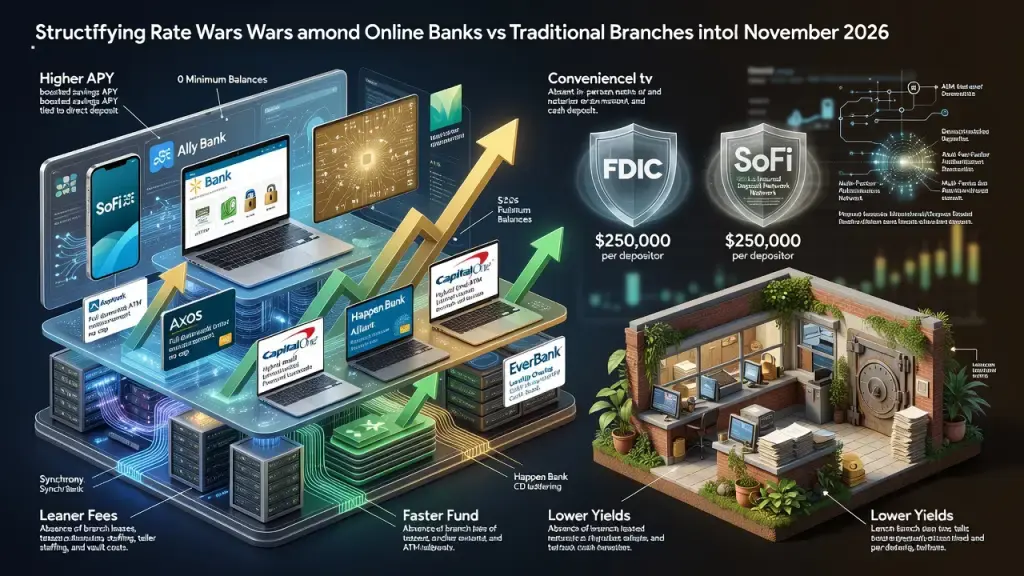
Online banks keep widening the gap with traditional branches on price. Higher yields, fewer fees, and faster account funding remain the core pitch, and a new comparison of more than 40 online banks and credit unions shows that gap holding steady heading into November 2026. The tradeoff is familiar: skip the teller window and the easy cash deposit, and in exchange, pick up a materially better savings rate and a leaner fee schedule.
Why the Online Model Still Wins on Price
The mechanism behind this is structural, not promotional. Without branch leases, teller staffing, or vault infrastructure, digital-first banks carry lower overhead, and that savings gets passed through as higher annual percentage yield and lower or no minimum balance requirements. SoFi's combined checking-and-savings account illustrates the model well, pairing an interest-bearing checking product with a boosted savings APY tied to direct deposit. Ally Bank takes a different angle, building a no-fee checking account around a modest base APY, cash-deposit access through Walmart partnerships, and a large fee-free ATM network. Axos leans into the ATM problem directly, reimbursing every domestic ATM fee with no monthly cap, which solves the single biggest friction point of branch-free banking: getting cash when you actually need it.
Where the Convenience Trade Shows Up
Here's the catch that doesn't always make it into the marketing copy. No branches means no in-person troubleshooting, no notary services in most cases, and cash deposits that range from inconvenient to outright unavailable. Some institutions, like Capital One, split the difference with a hybrid model - competitive digital rates paired with a limited physical footprint of branches and cafés. Others, like Alliant Credit Union for personal loans or EverBank for CD laddering, specialize rather than try to cover every product category. Happen Bank's LevelUp Checking and Synchrony's high-yield savings with ATM access both show how niche features - debit card cash back, ATM-linked savings - are becoming differentiators rather than afterthoughts.
Due Diligence Still Matters
None of this works without insurance backing. Every legitimate pick should carry FDIC or NCUA coverage, protecting deposits up to $250,000 per depositor, per institution, per ownership category - SoFi's expanded program through its Insured Deposit Network is a notable exception worth reading the fine print on. Fintech apps that aren't themselves chartered banks route deposits through partner institutions, so it pays to identify that partner and confirm the insurance chain before moving money. Security basics - multi-factor authentication, encryption, account alerts - are table stakes, not bonus features.
- Confirm FDIC or NCUA insurance before opening any account
- Compare APY against direct deposit or minimum balance requirements, since advertised rates often come with strings attached
- Check ATM network size and out-of-network reimbursement policy
- Review cash deposit options if you handle physical currency regularly
- Read partner-bank disclosures for any fintech app that isn't itself a chartered institution
Fair enough - no single online bank wins on every category. The sensible approach is matching the account to the actual use case: a high-yield parking spot for savings, a fee-free checking account for daily spending, or a specialized lender for a large personal loan. Chasing the highest headline rate without checking the conditions attached to it is how depositors end up disappointed come statement time.